





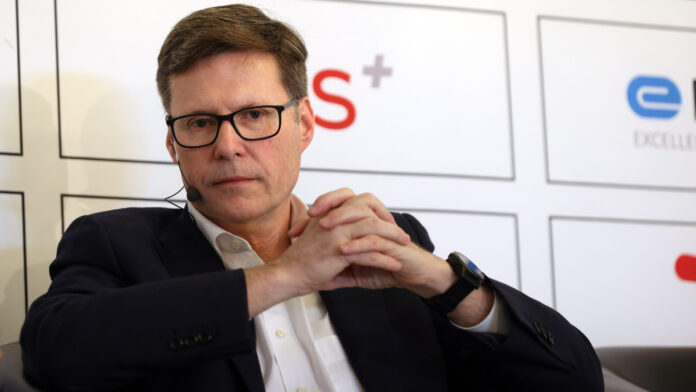
FULL marks for Duncan Wanblad’s powers of restraint. In an interview with Miningmx he could not be tempted into sounding a triumphant note notwithstanding the advent of Anglo Teck, the merger of his Anglo American with Canada’s Teck Resources.
The $60bn deal, which received shareholder and government approvals last year, is the only major transaction between diversified miners in recent years.
“Big M&A [mergers & acquisitions] are tough to do. Very tough,” said Wanblad, Anglo CEO since 2022. “It ultimately relies on an alignment of vision. The numbers are very important, but they’re not the only things that count.”
One feature of Wanblad’s approach has been his willingness to enter into cross-boundary partnerships with neighbouring miners, primarily in Latin America, where his focus lay while he was head of Anglo’s base metal assets from 2013 to 2019. Half of this time Wanblad was also head of strategy and business development.
In 2014, he led Anglo into a joint venture with Brazil’s state-owned miner, Vale, on its Serpentina iron ore deposit, next to Anglo’s Minas Rio mine. Then, last year, a partnership was signed with Chile’s Codelco involving Anglo’s Los Bronces and Andina, the state miner’s neighbouring operation.
The relationship with Teck was long in the making and operational. A collaboration between Teck’s Quebrada Cabra mine in Chile and Anglo’s Collahuasi started “so long ago that I can almost not remember when we started thinking about desalination plant synergies between those two operations”, Wanblad said. “Then you get to know the company. We were on a huge transformational journey, and they had more or less just completed theirs.”
What emerged from this industrial logic was the full-blown merger of the two companies, though it also involved significant concessions to Canada, including headquartering Anglo Teck in Vancouver. (It’s a move with important personal consequences for Wanblad. Getting to London, where Anglo Teck will have its primary listing, is a near two-day trip.)
Enlisting the support of Mark Carney’s government was no simple matter either for Anglo. Teck has a position in Canada’s corporate landscape akin to Anglo’s in South Africa, viewed as a national asset. Glencore’s proposed takeover of Teck failed because it wasn’t able to convince the Canadian firm’s anchor shareholder, Norman B Keevil, of its merits. “Canada is not for sale,” the 87-year-old entrepreneur told Glencore in 2023.
A year later, Glencore’s bid was over. It became one of four failed major M&A deals over a three-year period in the mining sector. BHP twice failed to merge with Anglo, first in 2024 and again late last year. Then in February, Rio Tinto abandoned its proposed takeover of Glencore. Styled as a “merger”, the deal lacked a premium that Glencore believed was required, especially as Rio sought to chair the board and appoint the CEO and thereby lead the executive.
While Anglo’s deal with Teck acknowledged national sentiment, it was also structured as a merger of equals — no upfront premium, in other words. Unlike GlenTinto, it was also big on the so-called soft issues. In return for moving to Vancouver, and having Teck’s Sheila Murray chair the combined board, Wanblad will be CEO, with Teck boss Jonathan Price as his deputy.
Anglo Teck rerating …?
Analysts expect a massive rerating of the combined company over the next 12 to 18 months. “The proposed merger … to form Anglo Teck is transformative, creating a top-tier copper producer with an 80% copper earnings exposure,” said Citi analyst Ephrem Ravi.
The bank values Anglo Teck at £50 a share, but also factors in other value additions, such as the potential for an improvement at Teck’s struggling copper mine, Quebrada Blanca, worth £3.30 a share, and an increase in Anglo’s own copper production numbers, worth £4.60 a share.
In addition to operational improvement at both Teck’s and Anglo’s copper mines, there’s a third element in the expected increase of the copper price. After years of promising record supply deficits, that moment is finally here, analysts said.
“Copper fundamentals are attractive, with the market likely to move into a deficit in 2026/2027,” said Myles Allsop, an analyst at UBS. The bank expects demand growth to remain resilient at between 2.5% and 3%, as against mined and refined supply growth of less than 1%, a development that will result in inventory drawdowns.
“Near term we see potential for the copper price to consolidate after the sharp increase to record highs at the start of 2026, which was largely driven by speculative activity, with physical signals not yet tight,” said Allsop.
Commenting on M&A last year, law firm Herbert Smith Freehills Kramer said “megadeals” also drove the market across all sectors in 2025, lifting deal values 40% to $4.3-trillion by the end of the year. But heavy lifting was required. Shareholders could not expect to have their wishes fulfilled with a snap of their fingers. That’s the lesson big mining seems to be learning.
“We were reminded that M&A are about resilience, adaptability and creativity,” said Gavin Davies, head of M&A at Herbert Smith Freehills Kramer. “Despite early uncertainty, the market rebounded strongly in the second half of 2025, driven by strategic ambition and megadeals.”
This article first appeared in the Financial Mail.