





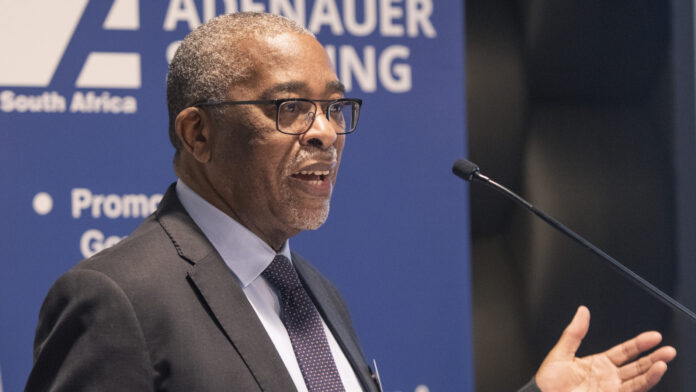
WHEN it comes to BEE sceptics, there are few more vociferous than Moeletsi Mbeki, a man who, as the son of Govan Mbeki and brother of former president Thabo Mbeki, is as close to ANC royalty as anyone.
When empowerment was first mooted back in 1991, Mbeki believed it was the wrong way to wrangle an economy dominated by whites into one that reflected society.
“The challenge was to get black people to become entrepreneurs. But giving them shares in existing companies not only didn’t do that, it didn’t grow the economy,” he said last year.
Mbeki says many believe, wrongly, that BEE was a creation of the ANC. “Actually, this was devised by Afrikaner nationalists in the 1990s as a way of weakening the nonracial character of the ANC. Essentially, the ANC leadership was bribed, and lost its true multiracial character as a result.”
What happened afterwards, Mbeki says, was predictable: many in the party’s top echelons became fabulously wealthy as large companies struck “broad-based” deals, effectively trading stock for political access. It was crony capitalism, South African style.
The structural problem with BEE is that it disincentivises young black professionals from becoming entrepreneurs, he says. “We’re shuffling existing assets, breaking them up to create so-called black-owned companies, like the coal mining companies. Those are not new companies, those are subsidiaries of old companies like Anglo.”
The grumbling around BEE has reached a crescendo in recent months. This has been amplified by those who would never have liked the policy anyway, even if it had been flawless, as well as by younger people who feel it hasn’t worked for them.
“It has never felt to me that the policy benefits the man on the street,” a young entrepreneur named Sipho Ndimande, who launched his own streetwear store, Kickbox, in 2019, told me last year. Instead, he said, the “same sort of people” benefit, usually the politicians.
Faced with similar complaints, President Cyril Ramaphosa said last month that the government is “undertaking a review to refine, realign and strengthen” BEE to ensure it “supports greater transformation and inclusive growth”.
The outcome, and the future of transformation, very much hinge on just how honest this review will be about the successes and failures of the policy.
To be clear, there are many who feel it does work, such as Afika Soyamba, who co-founded broadcast technology company Amafu.
“I have,” he said on social media when challenged to say who BEE has actually empowered. “Through access to an industry that was historically closed.” Scrapping it will be a regression, Soyamba said.
“Fix the leaks, close the loopholes. Build real economic participation,” he urged.
And research in 2015 by consultancy Krutham showed that a net R317bn had been created for black individuals, and while R196bn went to “strategic partners”, R52bn went to staff schemes and R69bn to community schemes.
But is this just a transfer of existing wealth, as Mbeki contends, or can this legitimately be hailed as transforming the economy by creating new wealth where none existed before?
Any “review” of BEE will also have to consider the counterfactual: whether entrepreneurs like Soyamba would have prevailed anyway, without the policy.
But discerning who succeeded specifically because of the policy, not just incidental to it, is tricky. Last week, at News24’s On the Record summit in Cape Town, many of the speakers debated precisely this topic, and the impression left was hardly a ringing endorsement of BEE.
On one panel, aptly titled “To BEE or not to BEE”, Saki Macozoma, a former member of the ANC’s national executive whose company Safika bought into giants like Standard Bank and Liberty in 2004, conceded that the policy has taken a wrong turn.
“Once you bureaucratise policy of this nature, you create a fertile ground for corruption,” he said. “What has gone wrong in society is the collapse of governance.”
Macozoma’s prescription, perhaps predictably as one of its major beneficiaries, is to rebuild it, rather than scrap it. Bring in new networks, scrap the political alliances that tainted it.
This is why so much rests on Ramaphosa’s BEE review. For one thing, the outcome will need to be insulated from the politicians, for whom the results seem very much preordained, if recent remarks by Deputy President Paul Mashatile in parliament are anything to go by.
Mashatile said BEE is here to stay, and spoke of “tightening the regulations” of funding organisations such as the Industrial Development Corporation (IDC) to ensure that BEE is “really implemented in a real way”. This suggests a doubling down on what’s there already.
Confusingly, Mashatile said the idea behind the policy has always been to create entrepreneurs. “Black people in this country must build enterprises. [They must] not be happy that they have 10% of a Van der Merwe business. We want to see black people building factories,” he said.
But BEE in its current form, Mbeki will argue, will never do this. Which isn’t to say there haven’t been fantastically successful black entrepreneurs; it’s just that this may not be attributable to the policy in the faintest sense.
And, damagingly, what you now have is a policy so intertwined in instances of corruption — think McKinsey, Trillian Capital and a thousand other tender scandals — that it will be hard to scrub the taint of suspicion off any new incarnation.
Ramaphosa’s review, then, will be a litmus test for how serious the ANC wants to be in building a workable economy, and how honest it wants to be about its achievements.
Does it have the courage, as Mbeki would want, to overhaul the policy to create a new class of black entrepreneurs and really catalyse a new era of growth? Or does it want a glossy self-congratulatory pamphlet, conflating cause and result, to use as superficial propaganda?
This is what is at stake — and for the ANC, denying reality is the surest route to exploring what new horrors lie below the 40.2% of the vote to which it tumbled in May 2024.
This article first appeared in the Financial Mail.