





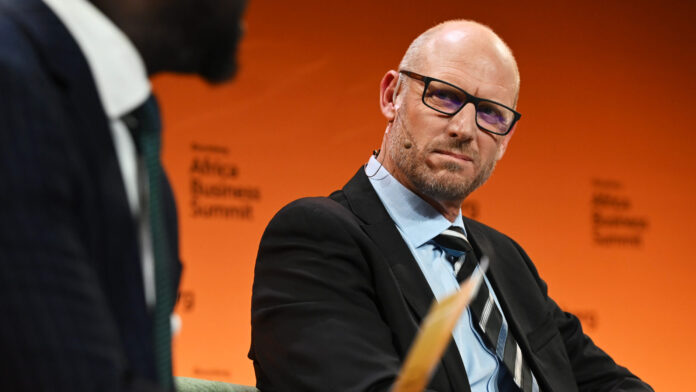
SIBANYE-Stillwater got its name as a result of offshore expansion, but following a damaging decline in metal prices that exposed its balance sheet, its new CEO is promising a homegrown approach to mining.
2021 was peak expansion for Sibanye-Stillwater. Valued at $16bn on the JSE – an all-time high – the company in that year unveiled a $1bn deal for two mines in Brazil. It was the latest in a string of expansions driven by the group’s founding CEO, Neal Froneman.
If concluded, the transaction would have seen Sibanye-Stillwater developing new mineral production on three fronts: the Keliber lithium project in Finland; an option to develop a lithium/boron project in the US; and in Brazil, the reopening of the Santa Rita nickel-cobalt and Serrote copper/gold mines. This was in addition to platinum and palladium recycling output in the US, and platinum, palladium and gold production in Sibanye-Stillwater’s South African base which, crucially, provided the bulk of the group’s free cash flow.
The platinum group metals (PGM) market was buoyant at the time, thanks to rocketing palladium and rhodium prices. Then, suddenly, the bottom fell out of the market. In a trice, Sibanye-Stillwater’s balance sheet looked dangerously over-exposed – as some analysts warned it might do. Trouble also came in the form of Appian Capital Advisory, the seller of Santa Rita and Serrote. It slapped Sibanye-Stillwater with a $1bn legal suit after Froneman decided against buying the mines.
It’s no coincidence, therefore, that five years later, Richard Stewart’s first major act as Sibanye-Stillwater’s newly appointed CEO was a $215m settlement with Appian. Sibanye-Stillwater had already decided not to exercise its US lithium option, and had shut some US palladium/platinum production. But in seeking to end the prolonged public legal tussle with Appian, the expense to shareholders notwithstanding, he closed the door on the group’s buccaneering past.
In its place, and with PGMs trading higher again, Stewart has set out a new domestic strategy that focuses on the contiguous expansion of the South African platinum business and sustaining gold output for as long as its price allows. A third leg is the development of a chrome business. While chrome is a PGM by-product, Sibanye-Stillwater is now giving it focus as a commercial proposition in its own right.
Sibanye-Stillwater retains an “offshore presence” in its massive R15bn Keliber lithium mine, opened in April and potentially due for expansion into refined metal. It also has a business in Australia, though it’s winding down. But if cash is to be made easily, South Africa is where the beating heart is.
“We have got an unbelievable portfolio today if we do nothing,” said Stewart in a presentation to investors and analysts on June 26. “I wouldn’t swap our portfolio of platinum group metals with any other anywhere.” Those are revealing words given Sibanye-Stillwater’s willingness to seemingly do anything offshore. “We have a two-million-ounce precious metals business that will continue for the next 20 years,” he said.
A catalyst to this strategy was the 2023 buyout of Valterra Platinum’s (then Anglo Platinum’s) stake in a joint venture that allowed the group freer rein over cross-boundary mining of the Kroondal and Rustenburg mines. By dropping boundaries between contiguous assets, and using more mechanisation, Stewart sees production growth in the existing portfolio, not shrinkage.
I wouldn’t swap our portfolio of platinum group metals with any other anywhere’ – Richard Stewart, Sibanye-Stillwater
By shelving mergers and acquisitions (M&A) and focusing domestically, Sibanye-Stillwater has removed major risk from the business: no deal risk, and known asset and jurisdictional risks. “The risk on projects on PGMs is unbelievably low,” said Stewart. “Geological risk has gone. People risk has gone. Infrastructure risk has gone. We understand it well.”
Seven PGM projects, each previously flagged to investors, now form a single strategy against which capital can be pinned. It perhaps makes for less interesting headlines (sadly), but better bottom lines. That would be one way of thinking.
Based on current planning, Sibanye-Stillwater’s PGM production is expected to fall to about 1.2 million oz/year by 2030 from 1.7 million oz in its last financial year. But if the switches are flicked on the expansion projects, output will actually be 300,000oz/year better off by 2030 at some 1.5 million oz/year. “We can also go up to 1.8 million oz/year if the markets support it,” said Stewart. “That is the optionality we have and why I say what I do about our portfolio.”
But it’s not inexpensive.
Stewart estimates total project spending of between R25bn and R26bn is required – a hefty capital expenditure bill, especially as only R8bn has been approved. Capex also excludes approved capital for the completion of Keliber, and other offshore options such as underground development of the Stillwater mine in the US, and Mt Lyell, a copper prospect that Sibanye-Stillwater’s board is yet to approve.
Sibanye-Stillwater estimates it can fund half of unapproved projects from cash. In practice this means it can plough in R4bn in growth capital in its 2026 financial year on the basis of R12bn in free cash flow, analysts at RMB Morgan Stanley estimate. The balance goes into debt reduction and dividends.
Delivery
Analysts have been generally receptive to the strategy. Nedbank Securities analyst Arnold van Graan said it provided grounds for a share rerating, which is exactly what Stewart is hoping for.
“Sibanye-Stillwater’s 2026 Capital Markets Day affirmed our view that the company’s strategy is clearer, more streamlined and firmly focused on execution,” said van Graan. “We believe the table is set for a rerating; however, the key to unlocking this potential is delivering on its strategy and consistent operational execution.”
The question of delivery is pertinent. “The presentation focused more on the growth potential and less on the ability of the existing operations to meet guidance,” said RMB Morgan Stanley’s Brian Morgan.
We believe the table is set for a rerating – Arnold van Graan, Nedbank Securities
Morgan adds that the greater adoption of mechanisation when Sibanye-Stillwater expands into other orebodies raises the question of cost control, even though mechanisation tends to be more efficient. The new projects are mechanised and the company sees mechanisation rising from 38% to 64% by 2035.
Said Morgan: “From our vantage point we can’t yet say whether replacing older conventional mines with newer mechanised ones is a headwind or tailwind to costs on a R/oz basis. Medium-term capex comes in at about R7bn per annum, about R1bn per annum lower than we expected.”
Chrome-plated
For a company that sought diversification, there is a huge irony in that there is a degree of that under Sibanye-Stillwater’s nose. Chrome production last year totalled 2.3 million tons, about 10% of the supply produced by South Africa, itself the dominant player in the market with about 60% of global supply. In terms of Stewart’s plans, however, this could be doubled.
Under a previous chrome marketing agreement (CMA) with Glencore, Sibanye-Stillwater took a price discount on production. But a renegotiation of the agreement, finalised last year, has incentivised the company to increase output. In addition, the with Glencore ends in 2031. Given the scope of PGM expansion envisaged by Stewart, there’s a possibility Sibanye-Stillwater will become a four-million-ton-a-year chrome producer.
“Sibanye is already the fourth-largest chrome producer globally, and this will make it significantly larger than its next peer,” said analysts at RMB Morgan Stanley.
Said Stewart of chrome: “It’s no longer just a byproduct in our thinking. It’s a deliberate additional value stream that improves margins and strengthens project economics. Where we see a pathway, it’s in becoming a top five, significant chrome producer in the world.” And is there any remnant interest in M&A?
It remains an option. “I’d love to own more of DRDGold,” said Stewart of his group’s 50.1% stake in the gold retreatment business. “But is today the time to do that? Gold expansion into Africa wasn’t ruled out, but it’s not imminent, especially given premiums placed on gold assets currently.
“That’s not where we see the best returns. Today, we see the best returns going into PGMs.”
This article first appeared in the Mining Yearbook which you can access in PDF format here.