


IS Gold Fields being unfairly penalised for its struggles with regulators? Yes, in the view of analysts who say the firm’s lagging share price performance is at odds with its improving cash flow generation.
Gold Fields is embroiled in two ‘non-mining’ issues. One is the uncertainty attached to the renewal of the mining licence of Tarkwa, a mine in Ghana that accounts for about a fifth of total production. The other is a costly permitting delay for Windfall, a gold project in Canada. Combined, these factors are overshadowing the group’s improved financial performance.
Shares in Gold Fields have vastly under-performed peers on a 12-month basis. AngloGold Ashanti is 65% higher over the period against an 18% gain for Gold Fields. Barrick, Harmony Gold and Newmont have also outperformed Gold Fields.
Yet shareholders in the miner are starting to see the benefits of a surge in the Johannesburg-headquartered firm’s cash flow, as last month’s interim results statement showed.
Adjusted free cash flow more than doubled to $2.2bn in the six months to end-June, from $952m a year earlier, while net debt fell 71% to $437m from $1.5bn.
Analysts now expect an improvement in shareholder returns. The group declared an interim dividend of R16.25 a share, up 132% year on year, and set aside another $500m for special dividends and share buybacks.
That said, headline earnings of 208 US cents a share had fallen short of the roughly 270c expected by the market, but Arnold van Graan, an analyst for Nedbank Securities, says free cash flow is the better measure.
Rising costs on Gold Fields’ books were also a concern, with all-in sustaining costs up 13% to $1,893/oz, though mining inflation is a shared, sector-wide issue and Gold Fields’ cost increases were broadly in line with peers.
Despite that cost pressure, the upshot for investors is the prospect of increased cash returns to shareholders, especially as the group’s balance sheet strengthens, say analysts at RMB Morgan Stanley. Gold Fields pays a base dividend equal to 35% of its free cash flow before spending on growth projects.
The bank said Gold Fields’ dividend yield still lagged AngloGold Ashanti, but it pointed out that special dividends and share buybacks were possible.
Gold Fields CFO Alex Dall said at the interim results in August that Gold Fields had ended the six months in a net cash position once lease liabilities were excluded. “Adjusted free cash flow increased to $2.2bn, while net debt reduced to $437m, significantly strengthening the flexibility on our balance sheet,” he said.
He noted that during the half, Gold Fields spent $600m on sustaining capital and $300m on growth, cut net debt by $800m and returned $1.4bn to shareholders.
Tarkwa
The stronger financial position has, however, been overshadowed by uncertainty around two of Gold Fields’ most important assets – Tarkwa and Windfall.
The mining lease at Tarkwa in Ghana expires in April 2027 and negotiations with the government over its renewal have yet to be concluded.
RMB believes the uncertainty has been a major reason Gold Fields has lost ground against global gold peers over the past year, given that Tarkwa accounts for about 16% of its estimated 2026 attributable production and 14% of group reserves.
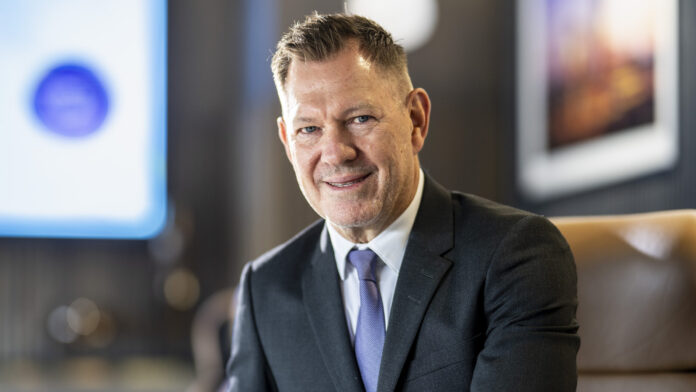
CEO Mike Fraser acknowledged this at the interim results presentation. “I think Tarkwa has been a drag on our share price,” he said.
Gold Fields had underperformed by about 10% over the previous six months, which Fraser said was “probably the kind of value attributable to Tarkwa or there and thereabouts”.
Gold Fields is also still waiting for environmental approval for Windfall – a high-grade underground gold project in Québec. Development costs are expected to come in at the upper end of its previous $1.7bn-$1.9bn estimate given at its capital markets day in November last year.
BMO Capital Markets has raised its Windfall capital estimate to $2.1bn from $1.8bn and pushed expected first production into the second half of 2029.
As previously announced, Gold Fields plans to step up spending over the next three years, which RMB says could top $2bn a year. This is intended to lift annual production from 2.4 million ounces in 2025 to between 2.8 million and 3.1 million oz by 2031.
A portion of that production growth will come from Gold Fields’ mine-life extensions and brownfield projects at operations including St Ives, Granny Smith, Gruyere, South Deep and Tarkwa, alongside Windfall, said Scotiabank.
Already, Salares Norte in Chile is making a significant contribution, generating just under $1.2bn in free cash flow in the first half as production rose sharply.
Fraser said the company was not pursuing growth simply for the sake of producing more gold. “Our focus on growth is growing cash flow per share,” he said. “It’s about growing the value of the company as opposed to ounces per se.”