


FOR most of the past decade Transnet has had an obvious problem: it wasn’t moving enough freight. Its latest results show good progress on that front, and suggest that the parastatal’s crisis of operations is gradually being replaced by a crisis of capital.
On balance, that’s a big improvement.
The operational numbers, reported earlier this month by Miningmx, are certainly heading in the right direction. Freight rail volumes reached about 168 million tons in the year to March, up from 160Mt the previous year and 149.5Mt at the low point in 2022/23. Revenue increased 7.1% to R88.6bn and Transnet reported a R4.6bn profit, its first annual profit since 2021/22.
But there is still a thumping great distance to travel. At its pre-collapse high point Transnet was moving more than 226Mt a year; current volumes therefore remain about a quarter below that level. Government is targeting 250Mt by the end of the decade, requiring another 82Mt or so from where Transnet stands today.
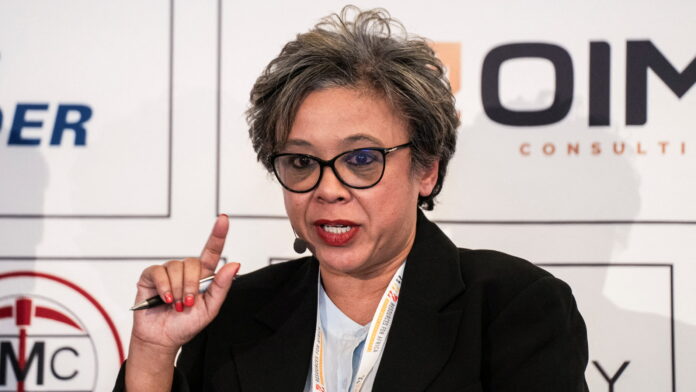
While CEO Michelle Phillips hailed the return to profitability as positive, she was frank that the turnaround was far from complete. “Is the turnaround job finished? Not by a long shot. We have a lot of work to do. The business still has to be financially sustainable,” Phillips said during the results presentation.
Still, the results demonstrate something of a sea-change. Two consecutive years of increasing volumes begin to look like a trend, particularly because mining companies themselves are reporting improved rail performance.
The reform programme is also moving beyond Transnet’s own operations. Eleven private train operators have been allocated slots representing up to 24Mt a year, with the first expected to begin operating in April 2027.
Unfortunately the R4.6bn profit comes with an asterisk approximately the size of a container ship.
Worse off now?
During the year Transnet transferred the assets of Durban Container Terminal Pier 2, with a carrying value of R3.3bn, into Durban Gateway Terminal and sold 49.999% of that company to International Container Terminal Services Inc for R10.5bn.
Transnet retains 50.001%, although management control passes to ICTSI. That transaction produced an accounting profit, including the associated fair-value adjustment, of an astonishing R12.5bn.
Peter Attard Montalto, MD of consultancy firm Krutham argues that, if you exclude one-offs, Transnet is actually in a worse position today than a year ago.
“That reinforces the urgent needs to separate in a sensible and well regulated way the asset companies from the operations companies to ensure that investment decisions are taken that are in the best interests of the country and not a monopoly whole with cross subsidy effects,” he tells the FM.
Outside of operations, the more interesting question raised by these results is how the next stage gets financed.
Revenue increased strongly, but EBITDA edged up only slightly, from R30.6bn to R30.9bn. Operating expenses increased 10.8%, faster than revenue, and its Ebitda margin slipped from 37% to 34.8%. Maintenance spend was 20% higher, and security costs 12.2% more.
The squeeze is particularly visible in rail. Freight Rail revenue increased 7.3% to R45.8bn, but reported Ebitda fell 36% to R5.7bn as costs rose sharply. Moving more freight and making more money from moving it are proving to be rather different things.
The cash-flow numbers tell a similar story. Cash generated from operations after working-capital movements fell from R28.6bn to R25.1bn. Cash flow from operating activities declined from R13.76bn to R8.50bn after working capital absorbed R8bn, compared with contributing R6.6bn the previous year. Finance costs increased to R15.5bn.
Transnet also raised R36.2bn of borrowings during the year and repaid R29.1bn. It means total debt now sits at R150.7bn.
A crushing lack of cash
This helps explain why the capital issue is becoming central to the Transnet story. A lack of cash means Transnet was actually in breach of covenants on affected loans and resulted in R21bn of borrowings being reclassified as short term. The breaches themselves are not new, and lenders granted the necessary waivers, but the persistence of the problem despite better operational performance is significant.
The Auditor-General issued retains its view that there is a material uncertainty related to the parastatal as a going concern. The board, meanwhile, explicitly cites the government’s R196bn guarantee support in concluding that Transnet should continue to have sufficient resources to operate and fund its investment programme.
And its investment needs are formidable.
Transnet plans to spend R129.1bn over the next five years. Remarkably, almost 90% is classified as sustaining capital. Only R13.1bn is expansionary. In other words, most of Transnet’s own investment programme is going into maintaining, replacing and rehabilitating the system it already has, rather than building the additional capacity required to reach 250m tonnes.
This is why the Pier 2 transaction at the Durban container terminal is arguably more interesting as a financing model than as an accounting event.
The deal with Philippine company International Container Terminal Services produced an accounting gain of about R12.5bn and played an important part in Transnet’s reported profit. It would therefore be misleading to treat the headline profit as evidence that Transnet’s underlying logistics businesses suddenly generated R4.6bn of surplus earnings.
But focusing too heavily on the accounting effect misses the more interesting aspect of the transaction.
Privatisation in miniature
Pier 2 brings an outside operator and outside capital into an asset which remains majority owned by the state. That is almost a miniature version of what may eventually happen across Transnet.
The old model effectively required the company to do everything. It owned the infrastructure, operated the trains and terminals, borrowed the capital and carried the investment risk. That became progressively harder as volumes collapsed, debt increased and decades of underinvestment caught up with the infrastructure.
The emerging model is different. Transnet increasingly becomes owner and manager of the network while private companies supply some of the trains, terminal operations and investment capital.
Rail reform demonstrates the potential scale of the change. The first private operators could contribute 24Mt, with private-sector capacity potentially increasing to around 52Mt over five years. Those operators will also have to provide or finance much of their rolling stock.
The bond market’s response to the results was subdued. That needs some qualification because global bonds were selling off sharply earlier this month, but the contrast with the rally in Transnet debt after Pretoria announced additional guarantees last year is still interesting. Improved operations have yet to produce a radically different credit story.
Two years ago the pressing question was whether Transnet could stop the collapse in freight volumes. There is increasing evidence that it has.
Now comes the more complicated question: who finances the railway Transnet is trying to become? Pier 2 and private rail access suggest the beginnings of an answer.