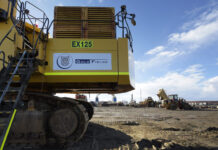



THE mining of surface gold dumps ought to be much simpler than underground mining. Instead of descending into the earth’s depths, which poses challenges from ventilation to safety, surface mining is a simple measure of dissolving deposits for processing.
In reality, no-one in mining fails to appreciate the complexity of mining waste ore, except the government, it seems. DRDGold is waiting on multiple permit applications before it can complete Vision 2028 — a R10bn expansion hatched in 2023 targeting a 25% increase in annual gold production to 200,000 ounces.
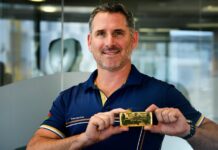
Niël Pretorius, the firm’s lawyer-turned-miner CEO, is understandably circumspect on the question of public sector inefficiency. “You can’t accuse any of these officials of being obstructive or intentionally difficult,” he said in an interview. “It’s the volume of work, the complexity, and the availability of resources,” he said of the department of water & sanitation, which is weighing applications for two water use licences.
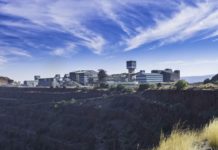
A government nod is also required before DRDGold can take “beneficial occupation” of RTSF, a new tailings dam — a colossal 800ha property near Carletonville designed to take 1.2Mt of tailings a month. The dam butts onto a wetland.
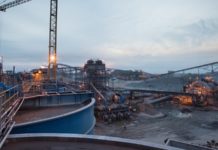
Once completed, RTSF will accommodate a doubling of DP2, a nearby processing plant which, with the tailings facilities, a newly laid pipeline, and a new reclamation station for the unmined dumps at Libanon (a closed mine), will make up an expanded Far West Gold Recoveries (FWGR), one of DRDGold’s two operations. The other is Ergo, near Brakpan, where new tailings facilities (Daggafontein) are also being commissioned to allow for an additional 20 years of operation.
RTSF is lined with plastic which, Pretorius said, was “baking in the sun”. To ensure its technical integrity, the dam needs filling before the summer rains. Pretorius, a farm owner, has extra reason for worrying about the El Niño event forecast for this summer.
“If we can have beneficial occupation by September, it means we can start the commissioning. If we don’t have it then, or if the weather starts looking less attractive for us … then September might become April,” he said of the dam’s commissioning.
FWGR makes up R8bn of DRDGold’s total Vision 2028 spend, which analysts believe will be value-adding for the company, though they are factoring in delays from the government, which seem inevitable.
“We believe the heaviest execution risk is now behind the programme as Daggafontein has been commissioned while DP2 is pouring its first gold,” said analysts at HC Wainwright, a New York-based investment bank. “In turn, the most notable debate has shifted from whether management can build Vision 2028 to when the permits can be obtained.
“We therefore plan to temper overall near-term expectations of improved production but still view the firm’s future as favourable. Longer term, we remain confident in management’s ability to deliver 200,000 oz of gold by the end of the decade,” they said.
Hannam & Partners, a UK investment bank, reduced DRDGold’s target price to R76 from R79 a share, focusing instead on a near-term catalyst of year-end production numbers, due in August. DRDGold has guided to 140,000 to 150,000 oz in gold.
“We have pushed out our assumptions for the completion of these projects, updated our capex assumptions and trimmed our production expectation for 2027-2029.”
Ever more growth
One person who does not fail to appreciate DRDGold, however, is Richard Stewart, CEO of Sibanye-Stillwater. The FWGR assets were vended into DRDGold by his company in return for a 50.1% stake, acquired in two tranches for R1.08bn in 2020.
That investment would cost R14bn today, which makes DRDGold among the smartest of investments for Sibanye-Stillwater. “I’d love to own more of DRDGold, absolutely,” said Stewart at a presentation last month.
Pretorius says Sibanye-Stillwater has “had so many approaches, people wanting to buy [DRDGold]”, but adds there’s no interest in either trading the stock or in Sibanye-Stillwater delisting it. “He’s holding onto the stock,” said Pretorius. But buying more shares has been ruled out: Sibanye-Stillwater is focusing on R20bn worth of expansions of its own in its South African platinum group metals assets and in keeping its gold assets profitable.
DRDGold has its hands full with Vision 2028, but further co-operation with Sibanye-Stillwater seems an obvious next step. Its Kloof mine, which is nearly exhausted, is cheek by jowl with DRDGold’s FWGR. “It’s not beyond the realms of probability that at some point some of [Kloof’s] plants might become available, and if they do, we definitely could put those to use — provided we get some additional resources,” said Pretorius.
For now, though, the focus is negotiating the government permitting process for its expansion. Timing is crucial, or the economic benefits will be delayed, which is contrary to the modern investment desire for jam today, not tomorrow. DRDGold’s capital expenditure profile tapers off significantly next year and in 2028. If the gold price remains at elevated levels, the company stands to become a powerful cash generator.
Asked how this will translate, Pretorius said simply “a better dividend”, rather than capital appreciation. “The upside that we’re hoping this offers doesn’t lie in share price appreciation so much as in dividend flow. It should be more about dividends,” he said.
A version of this article first appeared in the Financial Mail.