




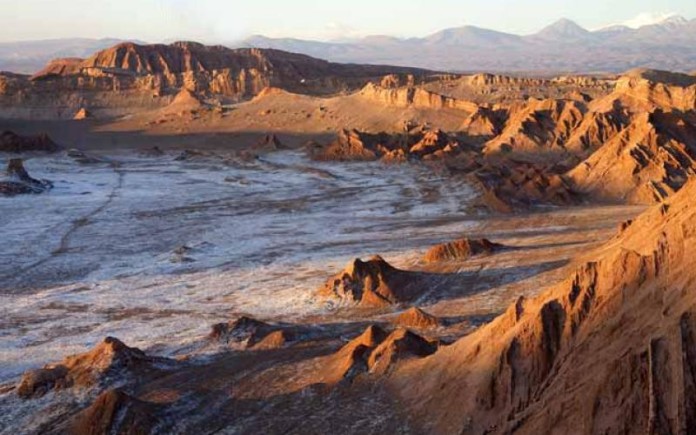
SALARES Norte, a mine high up in Chile’s Atacama desert, was the bane of Mike Fraser in his first year as CEO of Gold Fields. This year, however, it is promising to be his deliverance, according to the group’s trading statement and operational update for the six months ended June, announced on Tuesday.
An “outperformance” of Salares Norte will more than offset difficulties at its mines in Ghana and Australia this year and take Gold Fields’s output to as much as 2.6 million ounces, the higher end of its forecast production for 2026.
This is despite a deep freeze in the region during winter. The Financial Times reported in July that heavy snowfall disrupted power supplies, leading to the suspension of copper production at Lundin Mining’s Caserones copper–molybdenum operation. Antofagasta paused mining and processing for several days at its Minera Los Pelambres site, it said.
Asked whether Gold Fields had been similarly affected, the Johannesburg-headquartered miner told Miningmx last month that “… a little snow fell … but we haven’t stopped working. The storm has passed.” That supports performance in June, about which Gold Fields said in its operating update: “Salares Norte continues to outperform”.
“The mine is currently on track to exceed full-year guidance,” it said in its half-year update, adding that the group was focused on stable plant performance.
In 2024, Salares Norte’s pipes froze amid the early onset of sub-zero weather in the Atacama and just as the mine transitioned from project to critical ramp-up. The problems knocked the stuffing out of Gold Fields’s production targets and saw Fraser endure a nightmare first year in charge.
For this year, there are risks of missed production guidance at Gold Fields’s Gruyere mine in Western Australia owing to a decline in productivity and fleet under-utilisation. This was a function of high headcount turnover, the group said.
Tarkwa, the Ghana mine Gold Fields could potentially lose next year, was at risk owing to a slow start-up in the first quarter and notwithstanding a second-quarter recovery.
Windfall capex?
Gold Fields also said that project capital for its 300,000-oz-a-year Windfall project in Canada could be at the high end of last year’s adjusted forecast of $1.7bn to $1.9bn. It also said environmental permitting remained incomplete.
“Gold Fields will provide a further update once the EIA is approved and FID is confirmed, together with an updated project execution schedule and capital estimate,” it said, adding that the project would become “a cornerstone” of Gold Fields.
These statements about Windfall have alerted analysts. RMB Morgan analysts commented that “… management had previously highlighted that everything needed to be in place by June 2026 to avoid any possible schedule slippage”.
All-in sustaining costs (AISC) and all-in costs (which account for non-sustaining growth capital) are expected to be between $1,800 and $2,000/oz, and $2,075 and $2,300/oz, respectively, with AIC at the lower end of the range. This is owing to a relabelling of expenditure at Windfall relating to exploration costs.
In terms of interim earnings, Gold Fields said free cash flow before discretionary expenses (such as exploration) would double in rough terms to a range of $2.39bn to $2.64bn. Headline interim share earnings are expected to be 72% to 90% higher year-on-year in a range of $1.98 to $2.18 per share.