

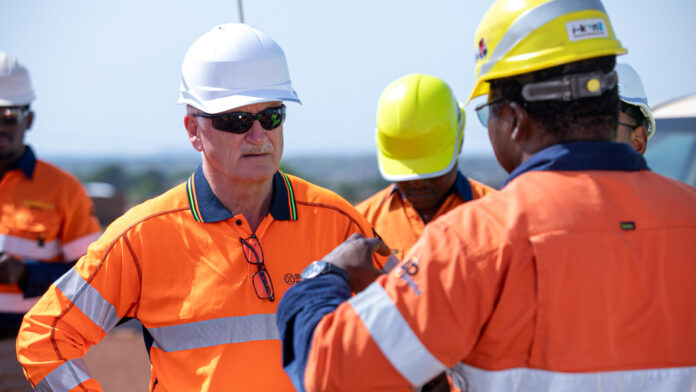
“IN an earlier life I must have been a fireman because instead of displaying rational behaviour in situations like this and running away, I tend to run towards them”. So said Ian Cockerill in 2024 interview with Miningmx shortly after taking up the reins at Endeavour Mining, the £4bn West African gold miner.
At the time, the company was recovering from the sudden departure of its CEO Sébastien de Montessus amid allegations of malfeasance. In an interview earlier this month, Cockerill said the event left “everyone in shock”. The months that followed were also difficult.
“Honestly, the first nine months were arguably the toughest nine months of my 50 years in the industry. It was really hard,” he says.
“Nothing seemed to go right for us. You just woke up every day and thought to yourself, it would be really nice if, just for once, the gold price went up, or commissioning was a bit smoother. It wasn’t catastrophic, but it just felt as if nothing went right.”
The inflection point, operationally, was the delivery of two projects. Endeavour is a company that favours project build. It also sets specific targets on exploration before achieving them. So it was a galvanising moment when Endeavour poured first gold at the Lafigué mine in Côte d’Ivoire in July 2024 having two months earlier completed the Sabodala-Massawa BIOX Expansion in Senegal.
Then the gold price rose.
Cockerill, 71, has seen a few cycles in his time. Asked to comment on gold’s historic price he forecast a potential doubling in shareholder returns provided the current price of more than $5,000/oz is sustained. Some $1bn in returns had been targeted for this year.
“Do I believe the gold price at $5,000 today is going to stay at $5,000? No. But I do think it will go higher, because exactly the same dynamic played out in 1979 and 1980. We’re seeing a repetition of that pattern. It’s going to go up, and it will come down.
“The question is where it stabilises. I think people are going to be surprised. My view is it will stabilise at prices higher than most would have believed a year ago.” He declines to offer a forecast, probably wisely.
Exploration premium
The market is beginning to recognise the turnaround in Endeavour. On a simple share prices basis only, the company has out-performed peers Agnico-Eagle and Barrick, tripling in value in 12 months. Its rerate is not unlike AngloGold Ashanti which has also emerged from operationally testing times.
“Endeavour had a difficult 2024 but operational performance and outlook has improved with higher production, lower capex and strong gold prices driving strong free cash flow, rapid debt reduction and cash returns in 2025/26,” said UBS in a note last year.
Through the cycle, however, the share’s sustained performance may rest on it excelling where it already has a reputation – which is in building projects. Endeavour doesn’t have the same production as its larger peers but it can benefit by scaling up from its lower base, especially if cheap ounces can be converted into cash flow.
“Another strong year for Endeavour,” said UK broker SP Angel of the miner’s full year production report. “Focus now seems to be on bringing Assafou into production in 2028, ramping up shareholder returns, and advancing their international greenfield exploration programme,” it said.
Assafou, in Côte d’Ivoire, is scoped to produce 329,000 annually in its first 10 years. If delivering Lafigué was a moment for Cockerill, Assafou is potentially greater with measured and indicated reserves of 4.6 million ounces compared to 2.9m oz, and at $1 per oz less discovery cost.
“The key area for us is that we have always been incredibly successful explorers. Over the last decade, we found over 21 million ounces of gold for $25 an ounce,” says Cockerill. “We’ve delivered five projects on time and on budget. That is a core part of our DNA.”
In December, the company set out a new 2026-2030 exploration programme targeting discovery of 12 to 15 million oz in mineral resources at a cost of less than $40/oz. The goal is to sustain 1.5 million oz in production by 2030 (from 1.2 million oz in 2025). “While an aggressive target, we believe the company is well-positioned to deliver, given the prospectivity of its focus areas,” said Raj Ray, gold analyst for BMO Capital Markets.
“Even if you took $100 an ounce of discovery cost, at the current gold price of around $4,000 an ounce with a $2,000 clear margin, every $100 I spend generates $2,000 of incremental value for this business,” says Cockerill. “A 20-bagger. There is nothing else I can do that adds more value to the base of this business than that.”
Risks
One departure is the announcement Endeavour had expanded its exploration to Eastern Europe’s Kazakhstan. A joint venture, unveiled in November, has been signed with East Star Resources, a London-listed exploration firm, that will see Endeavour invest up to $25m ahead of a feasibility study. Cockerill says the region is under-explored. Its geology indicates possible tier one gold resources.
Cockerill says the strategy of discovering high quality ounces is unchanged but the addition of a new geography comes against a backdrop of fiscal and legislative uncertainty in West Africa. While Côte d’Ivoire and Senegal have not suffered the political dissipation of the so-called Coup Belt nations, resource nationalism is back on the agenda for all emerging economies.
President Bassirou Diomaye Faye, Senegal’s president, was quoted by Reuters last year as saying new mining legislation was in the offing. Said Cockerill: “We recognise there are greater challenges there than in OECD-type countries.
“We have shown, over the last decade, that we are able to manage those risks and deliver outsized returns — building mines, keeping the business going,” he says.
Lifex projects
Other than the quality in Kazakhstan, as well as the potential in following the geology to Uzbekistan and perhaps further afield, Endeavour is looking to squeeze juice from its existing assets. “All our plants are being pushed hard; the rivets are popping on the mills because we’ve expanded them quite substantially,” he says.
What we are looking at is whether there are other ways of processing material — lower-grade material at higher prices, perhaps mini heap leaches that achieve lower recovery rates, but where you’re still making good money; certainly at $5,000 an ounce,” he says.