



HARMONY Gold today unveiled a major upgrade in its dividend policy in which it will pay up to 50% of net free cash provided debt is at manageable levels.
The miner kicked off a new era of returns with a record interim dividend declaration of R5.30 per share, equal to R3.38bn or 43% of free cash. This was despite announcing relatively disappointing operational numbers for the six months ended December owing to a cyanide shortage that affected the group’s South African mines.
As previously announced in a January operational update, gold production fell 9% to 724,099 ounces (22,522kg) and all-in sustaining costs rose by 21% to R1,180,367/kg, an increase exacerbated by higher royalties. Full-year gold production guidance has been maintained at between 1.4 and 1.5 million oz and AISC of R1,150,000/kg to R1,220,000/kg.
Harmony’s half-year numbers were also hit by a R1.1bn loss on derivatives after the silver price surged to just under $112/oz in December, an all-time high. The company also posted a R4.5bn loss on its hedge book.
The outcome for Harmony was a relatively modest 24% increase in basic earnings to R15,63 South African cents per share compared to the performance of other gold mining firms. Headline earnings increased 13% to R8.93bn.
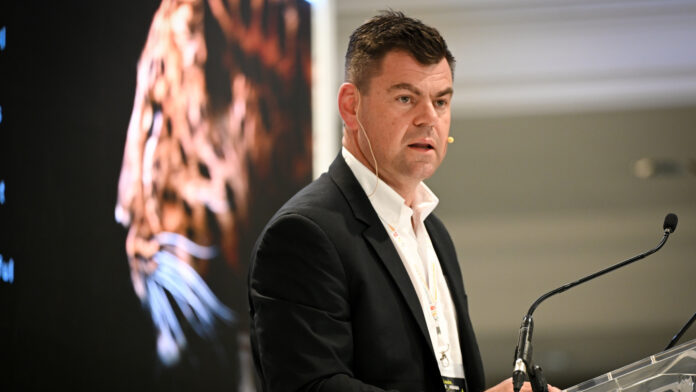
Commenting on the switch-up in dividend policy, Harmony Gold CEO Beyers Nel said: “Our approach ensures that investors benefit today”.
The revised policy now includes a base dividend and “upside participation” based on pre-dividend net debt to equity levels, he said.
When Harmony’s net debt to Ebitda is equal to or above 0.5x and below 1x, only a base dividend of 30% of net free cash is payable. But when the leverage of debt to Ebitda improves, Harmony’s board will consider increasing the dividend by 20% of net free cash. The company previously had a 20% to 30% of net free cash.
The six month period was a high action time for the company. After reporting net cash of R17.1bn at the close of the previous six months (2025 year-end), Harmony had slid into net debt of R5.54bn as of December 31. This was after closing its $1.01bn acquisition of MAC Copper which owns the CSA mine in Australia.
As a result, Harmony reported net debt/EBITDA of 0.18 times, below its 1x threshold. Boipelo Lekubo, Harmony’s financial director, said the company expected to be net cash by the end of the financial year.
The acquisition of CSA is part of Harmony’s strategy for copper production to comprise 40% of Harmony’s total production by 2035. Acquired with a nameplate capacity of 41,000 tons a year in metal output, Harmony forecast production from the asset this year of 17,500 to 18,500 tons or annualised 27,000 tons at the upper level.
Asked for details on the production plan at CSA, Nel said the new, lower forecast included a number of one-off stoppages. These consisted of a seven day safety related stoppage related to the upgrade of secondary egress (escape) systems, as well as an upcoming 60-day stoppage as Harmony rehabilitated steelwork in the shaft.
“Normalised for that, production is lower than what was previously guided by the previous operator,” said Nel. “But we are confident in what we have in terms of setting CSA up for the long term. It is a phenomenal copper orebody.”
Nel said last month Harmony expected to recapitalise and redevelop the CSA mine over two years. The group said today it had revised capex budget to R1.1bn for the mine as well as a further R5.6bn for Eva Copper, another Australian copper mine which is expected to cost a total of $1.55bn (R25bn) to build over three years.
Total capex for the 2026 financial year has been put at R18bn with the majority of spend on the South African mines and Hidden Valley in Papua New Guinea (R11.8bn).
Commenting on some of the production headwinds of the first half, Nel said: “The cyanide supply has normalised. We are working on contingency measures to make sure that we do not have an impact like this again.”
Mining costs globally are expected to increase if the US/Israel war on Iran is protracted. However, Nel said Harmony’s exposure – especially to diesel cost inflation – was low. “Our exposure across the whole portfolio is somewhat muted because of the different energy sources used in the labour-intensive underground operations,” he said.