



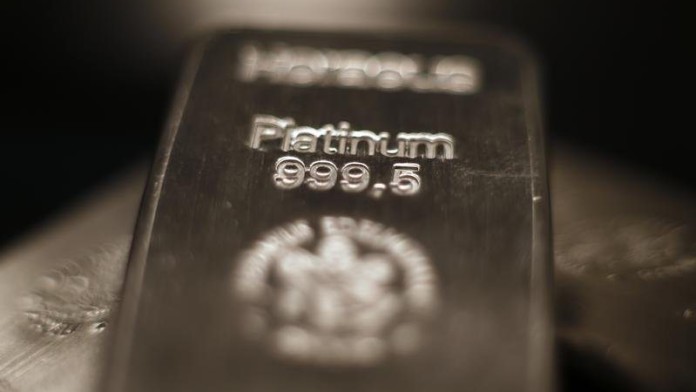
SINCE the decline of gold production in the 1990s, platinum has become South Africa’s most valuable strategic metal, and among its most important economically.
Of critical raw materials identified by the OECD in a recent report, South Africa has rare global domination. It controls 70% of platinum production, one of only three nations to have command over a single metal (China in magnesium, rare earths and graphite; the Democratic Republic of Congo in copper). Including gold and other platinum group metals (PGMs) such as palladium, rhodium and ruthenium, no other country has as much pre-eminence in a metals group as South Africa.
So it was high fives all round when platinum doubled in price last year. PGMs made up 27% of South Africa’s exported mineral sales in 2025. The industry employs a third of all mineworkers in the country.
The expectation is that the metal’s price will stay elevated for longer. That would be unusual for a market historically made up of “short summers and long winters”. But mining bosses and analysts say demand has revived in some critical areas, amid little evidence of meaningful supply growth either from primary mining or secondary recycling.
In fact, after a decade of underinvestment in resources and infrastructure, and a reluctance to bet big on the long-term cycle, the industry is structurally disposed to maintaining the market balance. Meanwhile, new sources of demand have emerged, such as ruthenium in data centres. But the most critical factor in short- to medium-term metal demand is the carmaking industry. Platinum and palladium in particular have been pushed into deficit for this and next year partly owing to this market force.
“I’m seeing many investors wanting exposure to hard assets, and in that bucket PGMs are very much centre stage” — Suki Cooper, Standard Chartered Bank
Sales of battery electric vehicles (BEVs) have slowed globally in favour of hybrids that combine petrol and battery power — and that supports the use of PGMs. The internal combustion engine (ICE) is also proving a long-lasting favourite with consumers, largely for reasons of cost and convenience. This, too, is a boost for PGMs used in production of “traditional” motor vehicles.
These conditions could drive yet higher prices. Adrian Hammond, an analyst for Standard Bank Group Securities, forecasts a 100% increase in the 3E (platinum, palladium, rhodium) basket price by 2027. In this scenario, platinum would be worth $3,000 an ounce, palladium $2,300/oz, and rhodium $35,000/oz.
“I’m seeing many investors wanting exposure to hard assets, and in that bucket PGMs are very much centre stage,” said Suki Cooper, global head of commodities research at Standard Chartered Bank, at the PGM Day conference last month. “Whether that’s concerns about autos or electronics — there’s very much been a shift towards wanting to have exposure to PGMs again.”
None, though, are as buoyantly optimistic as Impala Platinum (Implats) CEO Nico Muller. “I think the world has changed, and that change is going to last a number of years,” he said at the release of the company’s interim results in March. “The current supportive environment … is going to last longer than our initial expectation of 18 months. I think we are looking at at least three to five years.”
Shadow of the Strait
When the US and Israel attacked Iran, it triggered conflict in the Middle East that remains deeply consequential. A prolonged war could dent global economic growth, which would be destructive to PGMs because about 88% of demand is discretionary; that is, tied to carmaking and jewellery. The oil price shock delivered by Iran’s stranglehold over shipping in the Hormuz Strait “could change expectations around BEV penetration and hydrogen-related demand,” says UBS analyst Myles Allsop.
Yet there could also be a counterbalancing impact on mining production caused by shortages of diesel, acid and explosives. The early indications are that after the initial shock, in which some investors swapped PGM positions for cash, there has been stabilisation. Abhishek Tiwari, portfolio manager at the Public Investment Corporation, said at PGM Day that geopolitical distress will not unseat long-term demand, especially in the automotive market. “Once it ends, once the world normalises, there’s still going to be demand for PGMs,” he says.
For more than 10 years, platinum trundled sedately along between $800 and $1,000/oz. By mid-January it was worth $2,773/oz. Palladium and rhodium also raced higher. Without question, the short-term factors that drove the price spectacularly hard were outsized investment demand through ETFs, bars and coins. There was also an increase in stockpiled metal in the US ahead of tariffs.
Prices were given a push with the opening of platinum and palladium trading on the Guangzhou Futures Exchange, China’s first derivatives platform, in November. Volumes surged in the final two weeks of December. The June 2026 platinum futures contract averaged about 110t a day (about 3.5-million ounces) and 86t for palladium (2.8-million ounces), according to RMB Morgan Stanley. That compares to annual global platinum and palladium supply of about 7.2-million ounces and 9.6-million ounces. Higher lease rates and derivative demand for the metals “is likely to have contributed to both PGM price formation and price volatility”, says RMB.
The great EV retreat
Beneath the investment overlay, however, was a fundamental shift in the automotive market. Inventory among automakers stemming from aggressive purchases between 2020 and 2022 had been unwound. Once estimated to be 35% of the total car market by 2030, BEV penetration is now forecast to be 30% or lower.
One reason for this is a concern with BEVs’ travel range. Additionally, BEVs don’t perform as well as ICE vehicles in load-bearing situations, given the weight of the batteries. This limits vehicle capability in the industrial/commercial market.
Second, as BEV technology scaled up, the cost of batteries dropped — 20% in 18 months. This resulted in vehicle resale value losses of as much as 50% in the UK. Anton Smalberger, a senior manager for new energy business development at Toyota South Africa, says there “is no ownership incentive”.
Then there’s US President Donald Trump. His administration’s support for fossil fuels signalled a major switchback. The US also cut spending on charging infrastructure for electric vehicles and watered down vehicle emission targets.
Canada, bowing to automaker demands that “too strict, too soon” targets on EV adoption were hurting their businesses, altered and pushed out adoption targets. The EU loosened its emission goals by scrapping its 2035 target for BEV adoption.
“The emotional part [of a Lamborghini] is the vibration of the car … one of the biggest [factors in] the rejection of fully electric cars was the missing sound of the engine” — Stephan Winkelmann, Lamborghini
Automakers were already dabbing the brakes on BEV production. Now, they jammed their strategies into reverse, incurring billions of dollars in impairment costs in the process. General Motors incurred $1.6bn in charges. Archrival Volkswagen absorbed €4.7bn ($5.5bn) in charges tied to one of its subsidiaries, Porsche. When output of electric ID.3 hatchbacks ended in Dresden, it was the first time in 88 years that Volkswagen had stopped production at a German assembly plant.
The change in sentiment away from BEVs has extended to the luxury car segment, largely for aesthetic reasons. Ferrari has said it would not force its fans to give up the familiar roar of its petrol engines, the Financial Times reported. Bentley, which is also owned by Volkswagen, said last year it would continue selling plug-in hybrids beyond 2035, ditching its EV-only target.
“The emotional part [of a Lamborghini] is the vibration of the car, how you steer, how you brake, and one of the biggest [factors in] the rejection of fully electric cars was the missing sound of the engine,” Stephan Winkelmann, CEO of Volkswagen-owned Lamborghini, told the Financial Times.
Bentley, Lotus, Audi and Porsche have already scaled back plans to go fully or 80% electric over the next decade.
According to UK market consultancy Metals Focus, the upshot of policy shifts will increase the share of hybrid and pure ICE powertrains produced this year. “From a PGM perspective, this is supportive,” it says. “Demand in North America is now forecast to remain flat year on year at 2.3-million ounces, following two years of contraction.”
Johan Theron, head of corporate affairs at Implats, adds: “People are holding on to cars for longer. While this means fewer car purchases, it also means less scrapping.” Less scrapping means less supply from recycling, which comprised 23% of total platinum supply last year, according to the World Platinum Investment Council.
In the long term, however, electrification of drivetrains is an unstoppable force. Jakob Fleischmann, a partner at McKinsey & Co and formerly an automotive engineer at Mercedes-Benz, says BEV technology will eventually win out.
“We need to realise that the electric car is just so simple that ultimately it will be cheaper,” he says. “The combustion engine car has pistons, valves, emission treatment, all that complexity. The electric motor is dead simple — no gearbox — plus the battery.”
Caution over growth
As a result, South Africa’s mining companies are reluctant to throw investment dollars behind new expansion. “While this should support the much-needed development of new operations, the extended timelines for mining development mean that primary supply of PGMs will continue to fall, and thus current prices are likely to remain firm in the medium term,” says Northam Platinum CEO Paul Dunne.
Instead of outright growth, miners have sought production replacement. During the last upcycle for PGMs, share prices were severely damaged as the market was snatched from under the feet of those miners who went big on growth.
“I want to take you back to 2019, when I sat across the table from investors who basically said the company had become ‘uninvestable’,” says Muller. “I’d rather have a strong balance sheet, so we don’t get into that position again.”
Valterra Platinum CEO Craig Miller adds: “Prices have improved, but by our estimation we need platinum to be at a sustained $2,500/oz to give the confidence for future investment and ensure a 10%-20% return.”
“We need platinum to be at a sustained $2,500/oz to give the confidence for future investment and ensure a 10%-20% return” — Craig Miller, Valterra Platinum
Implats has an option in Waterberg Joint Venture, a palladium-dominant project in the northern part of the Bushveld Complex, but Muller is not particularly interested in its development. “We are acutely aware that it has a strong palladium bias, and that is probably the metal that we have the least long-term confidence in,” he says.
The outcome is ongoing deficits for platinum and, to a lesser extent, palladium, provided demand remains robust. As byproducts of platinum production, there’s little flexibility to improve the rate of production of other key PGMs such as ruthenium and iridium, key in data centres, and rhodium in the fibreglass industry.
The impact has meant a lot of excellent news for investors. After three years of drift, PGM miners have switched focus from capex to dividends. Valterra announced a R5.3bn special dividend as part of its year-end numbers on February 25. At 60% of adjusted free cash flow, Implats’s proposed payout was double its stated dividend policy. Northam was similarly generous, and Sibanye-Stillwater reinstated the dividend on newfound profit-making.
Dropping the farm fences
Miners are now looking at co-operation across adjoining properties.
Muller identifies properties north of the Dwarsrivier Fault in the Eastern Bushveld, where “there are some cross-border collaboration opportunities”. In terms of geographical footprint, this would include the Modikwa, Marula, Twickenham and Bokoni mines, as well as some undeveloped prospecting projects.
“If you reimagined the Eastern Limb, very few of the assets north of the Dwarsrivier Fault have ever been economically attractive,” he says. “But I think if we were to combine assets into a larger vehicle, as an example, there could be upside for the Eastern Limb, which does have a very healthy long-term resource base. I think that would be the focus for the next year or two.”
There’s also greater interest in sharing processing facilities. “Processing capacity will become available. I think that can be put to good use through the sharing of processing infrastructure,” Muller says. “I think it’s really critical for Southern Africa to protect beneficiation in-country.”
This strategy smacks of “dropping farm fences” or choosing to “mine out the tail”, which is the conscious action of a mature industry, a bit like South Africa’s gold industry 20 years ago, when resources became too deep to risk capital.
There are some exceptions on the growth front. Northam, for instance, is still considering incremental expansion.
Dunne says the Northam board approved a R500m capital programme that will provide an option to expand production at its Zondereinde mine to more than 400,000oz a year of PGMs from its nameplate 350,000oz a year.
Valterra is another that could increase production if it approves the Sandsloot underground expansion at its centrepiece Mogalakwena mine in Limpopo. The current target is a 10%-20% increase in PGMs in the project’s phase 1. A full build-out of Sandsloot could increase Mogalakwena’s production by 50%, Miller says, though he adds: “We will bring on production only if the market wants it.”
The only other major and short-term growth option in South Africa is Ivanplats’s Platreef mine, which neighbours Mogalakwena in Limpopo. Its 100,000oz a year in PGMs (plus gold) first phase was commissioned last year, with phase 2 coming this year and next year. When developed, it will mine 450,000oz a year with an option for an annual 1-million ounces third phase, markets depending.
“For now, we believe supply response will not be excessive, rather just enough to keep the market balanced,” said Bank of America in a recent report. A “major supply ‘cliff'” is unlikely, it added.
What a difference a few months make
“What a difference a few months make,” says Nedbank’s Arnold van Graan. In early 2025, platinum shares were depressed as companies sought survival strategies. Fast-forward to now, and cash flow generation has rocketed. “The PGM narrative has shifted rapidly from cutting spend and protecting balance sheets to record earnings, special dividends and renewed growth ambitions,” says Van Graan.
The focus now, however, shifts towards maximising the strong dollar basket price for metals. On this score, Standard Bank and Nedbank prefer Valterra and Northam. Northam recently completed a multiyear expansion to about a million ounces in annual production and is benefiting from the economics of its new scale with lower unit costs. Valterra recently completed R5bn in cost reductions and has implemented a value over volume strategy at Mogalakwena.
“We increase our price target on Northam from R350 to R700,” says Hammond. In a report last month, he doubled Valterra’s price target to R250 a share. “Long life, superior processing capability and Mogalakwena growth optionality support a high relative rating,” he says. “Management has done well to remove costs, though the company is most exposed to higher oil prices which could put cost guidance at risk,” Hammond adds.
“The PGM narrative has shifted rapidly from cutting spend and protecting balance sheets to record earnings, special dividends and renewed growth ambitions” — Arnold van Graan, Nedbank
However, the impact of mining inflation, owing to the Middle East conflict, is a danger. RMB Morgan Stanley analyst Brian Morgan has a downside rand metal basket price of R30,000/oz (compared to an average spot basket price of about R43,000/oz over the past month, based on Johnson Matthey data weighted to relative production of platinum, palladium, rhodium and gold).
“PGM commodities and equities are not priced for a prolonged Strait of Hormuz closure, we argue,” says Morgan. At a PGM basket of R30,000/oz there is downside risk for all platinum counters: 22% for Impala, 40% for Valterra, 53% for Sibanye, 59% for Northam, the bank says.
Northam and Valterra have long been the favourites in the platinum sector. Implats and Sibanye-Stillwater are less favoured, the latter because production is expected to drop to about 1.5-million 4E ounces by the end of the decade from 1.73-million as reported in its 2025 financial year.
According to RMB, however, Northam is now fully priced. It’s still the top call for Standard Bank. Nedbank also favours the stock.
This article was first published in the Financial Mail.