





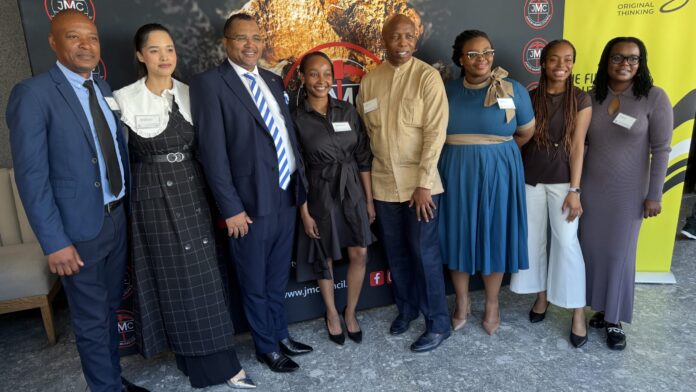
AGAINST the backdrop of Cape Town’s annual Investing in African Mining Indaba, ENS and the Junior Mining Council (JMC) hosted a high-level networking breakfast at Zest Restaurant, bringing together stakeholders from across South Africa’s junior mining value chain. The gathering reflected the core message of this year’s Mining Indaba theme, “Stronger together: Progress through partnerships.”
Held on the sidelines of the global mining event taking place from 9–12 February 2026, the breakfast provided an informal yet strategic platform for industry leaders, investors, mining executives, legal and technical practitioners, and key policy stakeholders to connect, exchange insights and strengthen relationships beyond the formal conference programme.
While the Mining Indaba remains the premier meeting place for African and global mining leaders to engage on investment, policy and sustainability, the ENS–JMC breakfast demonstrated that meaningful progress is often driven in smaller, collaborative forums where dialogue is direct and partnerships are built.
A collaborative welcome
Welcoming guests, JMC President Fred Arendse expressed his appreciation for the strong turnout and the enduring partnership between the Council and ENS.
“It is a privilege to warmly welcome you to this collaborative networking breakfast, hosted in partnership with ENS,” Arendse said. He extended a special word of thanks to ENS for its continued support and leadership in the mining legal landscape, and its commitment to advancing sustainable mining development in South Africa and across the African continent.
Junior mining: central to the sector’s future
Central to the discussions was the strategic importance of junior mining, which the JMC continues to emphasise as fundamental to the future of the mining industry. Junior miners play a critical role in early-stage exploration, mineral discovery and resource definition, while driving innovation and providing the long-term pipeline of producing mines.
Without a thriving junior mining ecosystem, Arendse noted, there can be no sustainable future for the sector and no security of supply for minerals required by domestic industries and global markets.
Policy, regulatory and systemic challenges
While the mood was optimistic, Arendse acknowledged the realities facing junior miners. Regulatory certainty remains a key concern, with the sector requiring a stable, transparent and predictable policy environment to unlock early-stage investment. Persistent administrative challenges within the mineral rights system continue to affect project timelines, costs and investor confidence, with junior miners particularly vulnerable to delays in applications, appeals and approvals.
The JMC remains actively engaged in legislative reform processes, participating in consultations and submissions on proposed amendments to mining legislation and related regulatory instruments. Arendse stressed that effective reform must be practical, consultative and designed to strengthen investor confidence while advancing transformation and sustainability objectives.
South Africa’s exploration environment also remains constrained, with exploration expenditure lagging behind the country’s geological potential. This underscores the need for targeted policy and fiscal interventions to incentivise exploration, support risk capital and encourage new entrants into the market.
Beyond policy, junior miners continue to face systemic constraints, including energy insecurity and logistics bottlenecks at rail and ports. These challenges disproportionately affect smaller operators who lack the balance-sheet capacity to absorb inefficiencies.
Social licence and ESG expectations
Another defining theme was the growing importance of social licence to operate. Mining is increasingly evaluated not only on profitability, but on ethical leadership, environmental responsibility, community impact and inclusive economic participation.
While junior miners recognise these responsibilities, Arendse noted that ESG compliance requires enabling frameworks, practical implementation models and appropriate support, particularly for smaller operators.
ENS: facilitating progress through partnership
From ENS’s perspective, the partnership with the JMC reflects a shared commitment to building a resilient, responsible and investment-ready mining sector. ENS emphasised that its role extends beyond managing legal risk to facilitating progress across the full mining lifecycle — from exploration and project financing to development, mergers and acquisitions, and dispute resolution.
In an increasingly complex regulatory environment, ENS supports mining companies by helping them navigate regulation, structure compliant and bankable transactions, and integrate ESG considerations in a practical and sustainable manner. The firm also highlighted the importance of facilitating constructive dialogue between miners, regulators, investors and host communities to support long-term project viability.
A clear call to action
Reflecting on the Mining Indaba theme, Arendse reaffirmed the JMC’s commitment to advocating for a policy environment that enables junior miners to grow, explore and develop projects efficiently, responsibly and sustainably.
The JMC will continue engaging with government, regulators, investors and industry partners to ensure junior mining is recognised as a critical driver of economic growth, job creation, industrial development and long-term mining sustainability.
“Junior mining must not be treated as an afterthought,” Arendse concluded. “It is the pipeline through which the future of mining is secured.”
Closing the breakfast, he thanked ENS for co-hosting the event and guests for their continued contribution to building the future of mining in South Africa and across the continent, wishing all delegates a successful and impactful Mining Indaba week.