

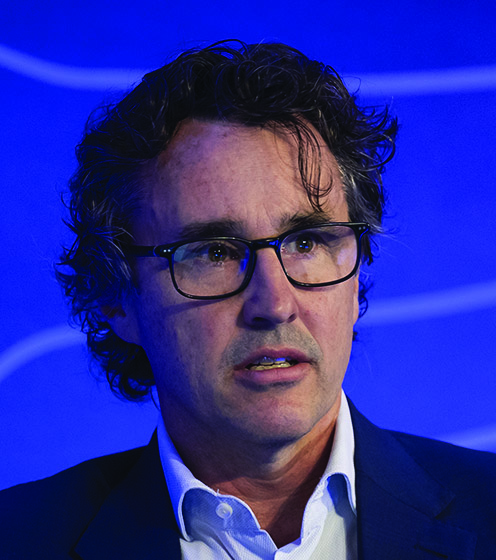

Simon Trott
CEO: Rio Tinto


‘We want to create a sharper, simpler business capable of faster decision-making and improved performance’
RIO Tinto Group has been through its fair share of turmoil over recent years. In the wake of its bombshell sexual harassment report and the destruction of a sacred Aboriginal site in Western Australia, it took former CEO Jakob Stausholm five years to restore the company’s reputation and reset relationships. However, Stausholm’s successor, Simon Trott, formerly Rio’s head of iron ore, has a fresh task of an entirely different magnitude altogether.
That’s because the Australian group announced on January 8 it was in talks to acquire Glencore by means of an all-share ‘merger’ — a piece of corporate work that will make it the world’s largest miner with an enterprise value in excess of $260bn. It will be a formidable company if it takes shape. Glencore brings capacity to double copper production by 2035 by means of a $24bn capital programme.
Rio has outlined $13bn in new iron ore investments and bought heavily in lithium exposure. It’s all ifs and buts at the moment though and whatever we say may end up being surpassed by events. Rio had until February 5 to make a formal offer. There can be no surprise, however, that Rio is moving in this direction. Even without the Glencore deal, Trott was hired on a mandate to rewrite Rio’s investment proposition. The $5bn-$10bn sale of non-core assets, including South Africa’s Richards Bay Minerals, was flagged last year and there has been speculation Rio could sell its stake in Guinea iron ore mine Simandou to help unpick its dual-listed structure. While the deal with Glencore will supersede all that, it’s clear Rio Tinto will never be the same.
LIFE OF SIMON
Trott has been on the Rio Tinto executive committee since 2018, first as its chief commercial officer, then as the chief executive of its iron ore business and now as CEO. Prior to that he held senior management and executive roles throughout the group, including salt, uranium, borates and diamonds, at operations in most of Rio’s operating countries. He holds a Bachelor of Agriculture from the University of Western Australia and a Graduate Diploma in Finance & Investment, and is a graduate of the Australian Institute of Company Directors.