




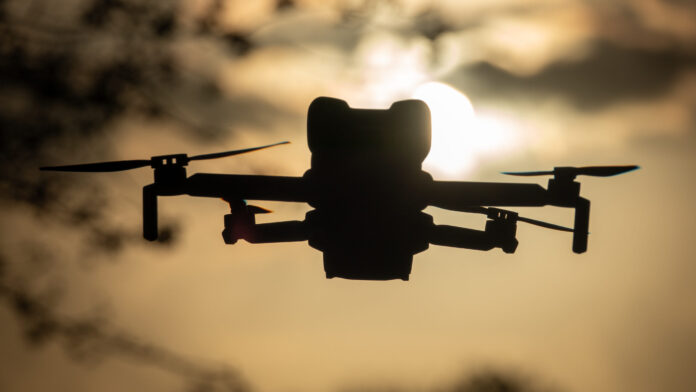
The shooting down of a drone over Lithuania by Nato forces last month was construed as a worrying escalation in the Russia-Ukraine war, now in its fourth year. If the incident does represent a broadening of the hostilities, drones will be at the vanguard of the conflict. That’s troubling for Nato, because the West is far behind China in securing the primary resources and industrial capacity necessary for the manufacture of drones at scale.
Drone use in war is on the rise. Where tanks, aircraft and battleships of the early 20th century were followed by low-volume but high-precision guided-missile technology, today’s “third era” of weaponry is in the field of high-volume, high-precision drone manufacture. Drones are inexpensive to assemble, easily operated without much training, and deadly.
An estimated 15-million units are expected to be deployed by Ukraine this year alone — a staggering increase from the 1.5-million units in 2024, according to a report by Canadian bank BMO Capital Markets. It estimates that $150bn has been pledged by governments for the development and manufacture of these new weapons and that about half of that amount has been committed to date.
As in any war, however, it’s in the control of the supply chain that the true advantage lies. That’s the reason the US, through its Project Vault programme, has started stockpiling the metals and minerals needed for warfare, as well as the means for processing the minerals on home soil. For drones in particular, three minerals stand out as critical: gallium, rare earth metals and germanium.
The average drone operating on the Ukrainian battlefield contains 46g of rare earths (typically neodymium in the NdFeB magnet) and about 0.1g of gallium. For germanium, it’s about 1g. Fibreoptics remain the largest germanium end-use sector but its application in defence is in infrared optics or thermal imaging. In a yet more arcane application, germanium is used in newly developed tethered drones — literally a fibreoptic strand connecting a drone with an operator. Some of the strands are 30km long but no wider than a human hair. Their aim is to bypass signal jamming. Each tether requires 0.1g of germanium. These are small amounts on a unit basis, true, but it’s the effect of this marginal demand on the market balances that ultimately matters.
This year’s drone manufacture for the Ukraine war effort requires about 15t of new germanium supply against the total global demand last year of 343t, according to research house S&P Global. That’s about 4.3% of global demand that didn’t exist two to three years ago. This recent demand for germanium in drones has contributed to the metal’s ongoing global market tightness, which sent prices soaring from a pre-2025 average of about $2,000/kg to more than $11,000/kg now.
China in the driving seat
What’s “critical” about these metals is that their downstream processing is super niched. China has the whip hand, with control of more than 90% of germanium refining capacity. A ban on exports to the US was imposed by China in 2024 and then subsequently lifted until the end of this year, though — instinctively — licensing requirements and restrictions on military uses remain.
Given China’s ban on germanium exports, the West is rushing to find its own sources. Complicating the picture is that germanium isn’t, in itself, a primary mined product. It often occurs with zinc, so commercially supply relies on good market factors for zinc first. But production does exist, though perhaps in some surprising places.
We expect drone and counterdrone technologies to become another important driver of government efforts to secure domestic production, strengthen processing capacity and reduce dependence on vulnerable foreign supply chains – BMO Capital Markets
Teck Resources, the Canadian firm that Anglo American is buying — primarily for its copper — is one downstream germanium producer. It recovers the mineral as a byproduct from its Trail smelter in British Columbia. Prior to Anglo’s offer, it was considering an expansion. Teck is also a potential joint venture for production at the Empire State Mines in New York.
Ivanhoe Mines, headquartered in Anglo Teck’s home of Vancouver, also produces germanium from its Kipushi zinc mine in the Democratic Republic of Congo. The miner this year discussed supplying the mineral to Project Vault via a smelting complex in Tennessee.
These are not the only producers, but the point is that supply is a concern, as in other key metals. Rio Tinto and aluminium company Alcoa produce some gallium; MP Materials in the US is the largest non-Chinese rare earth metals producer, but it relies heavily on the promise of government-sanctioned price supports.
For the US, a paucity of germanium and other metals is a national strategic weakness. The US defence department requires an estimated 3,000t–4,000t of specialised rare earth magnets annually, a figure expected to rise to 10,000t by 2030, says Sprott Asset Management senior portfolio manager Justin Tolman in a recent report. “While that may seem small relative to an approximately 250,000t global market, it is significant compared with just 20,000t–25,000t of ex-China rare earth magnet production today,” he says.
Global defence spending now exceeds $2.7-trillion annually, about $1-trillion more than in 2017, according to Sprott’s data. Says BMO: “We expect drone and counterdrone technologies to become another important driver of government efforts to secure domestic production, strengthen processing capacity and reduce dependence on vulnerable foreign supply chains.”
The defence ecosystem
In another telling development, the US Army has struck preliminary deals with miners to build critical minerals processing plants on military bases around the country. It is a first-of-its-kind initiative by Washington to boost domestic production of key materials. Companies such as REalloys Inc, Titan Mining Corp, ioneer and EnergyX have reached agreements with the Pentagon to build facilities for processing rare earth minerals, graphite, lithium and boron.
REalloys will construct a rare earth separation facility at the Tooele Army Depot in Utah, and production will be stockpiled on-site for military use, according to a US Army statement. Titan Mining will build and operate a graphite purification facility at either Pine Bluff Arsenal in Arkansas or Anniston Army Depot in Alabama. EnergyX and Sydney-based ioneer — the latter the only non-US company of the four involved and a one-time joint venture partner of Sibanye-Stillwater — will develop a lithium facility and a boron plant, respectively.
Modern defence systems are highly metals intensive, requiring copper for electronics, tungsten for munitions, nickel for aerospace applications and rare earth magnets for advanced guidance systems. The replenishment of munitions is also increasingly expensive – Baker Steel
For every drone on the attack there also has to be a defence system in place. “A single well-placed drone costing a few hundred dollars can now threaten civilian infrastructure costing billions,” says BMO in its report.
“This is driving a counterdrone investment cycle as governments build layered defence systems to mitigate this threat.” Again, gallium and germanium are key, but so are other metals such as the rare earths gadolinium, yttrium, ytterbium and samarium.
So are more mainstream metals, including platinum and its sister byproducts. “Clearly the US needs to restock, and Europe is trying to rearm, so there’s definitely going to be a demand pull, not just for platinum but across the platinum group metals (PGMs),” says Ed Sterck, director of research at the World Platinum Investment Council. Ruthenium, a PGM, is used as an alloying material with nickel and chrome in turbine blades for cruise missiles and similar applications, says Sterck. “The whole PGM complex benefits. There’s clearly a demand pull.”
Baker Steel, a US-based fund manager in resources, says: “Modern defence systems are highly metals intensive, requiring copper for electronics, tungsten for munitions, nickel for aerospace applications and rare earth magnets for advanced guidance systems. The replenishment of munitions is also increasingly expensive.”
The US government spent $11.3bn in the first week of the Iran conflict alone. The Pentagon has consequently asked Congress for an additional $87bn in spending, most of it to replenish its military resources.
“As supply chains become more fragmented and nations shift from decades of ‘just-in-time’ efficiency towards ‘just-in-case’ resilience, secure access to critical materials is becoming a strategic imperative,” says Tolman. “Countries that cannot secure the raw materials that their economies depend on risk losing economic competitiveness, technological leadership and, ultimately, national autonomy.”
This story first appeared on the FM. The FM and Miningmx are part of the Financial Mail Group.