


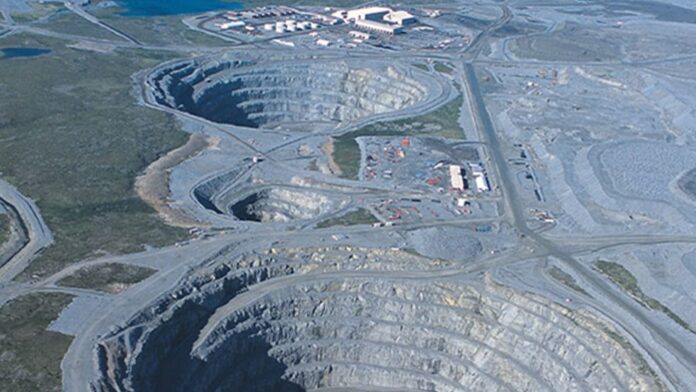
RIO Tinto has closed its last diamond mine, ending more than 50 years in the business as the world’s second-largest miner sharpens its focus on copper, iron ore, aluminium and lithium, said Bloomberg News.
The Diavik mine in Canada’s Northwest Territories has delivered its final production, with remaining stones to be cut and polished ahead of auction. Diavik was an engineering feat, built beneath a frozen lake and shielded by steep retaining walls. Its largest stone, a yellow diamond weighing 552.74 carats, remains the mine’s most celebrated find.
Rio’s diamond exit follows the 2020 closure of its Argyle mine in Western Australia, which was renowned for rare pink gems that commanded significant premiums. Argyle’s discovery began with geologists spotting diamonds in giant anthills in the Kimberley region.
“Forty years ago there were very few people who believed there were diamonds in Canada,” said Sophie Bergeron, MD of Rio Tinto Iron & Titanium and Diamonds. “To arrive at this milestone has required vision, courage and determination.”
The business has struggled in recent years, battered by a supply glut and rising competition from synthetic stones. Rio posted a $79m loss from its diamond unit in 2025.
Natural diamond prices have fallen more than 40% from their pandemic peak, with polished stones also tumbling sharply.
De Beers, the industry’s dominant force for more than a century, lost nearly $1.5m a day last year. Parent company Anglo American has written down the business three times in as many years, slashing its book value to $2.3bn from $9.1bn, and is now seeking a buyer.
Lab-grown diamonds — chemically identical to mined stones but sold at steep discounts — featured in nearly half of US engagement rings between January and August 2025. Factories across Surat are adding synthetic production lines, acknowledging the structural shift.
There are tentative signs of stabilisation. De Beers raised prices for stones above five carats by more than 5% at its February sale as supplies in some categories tightened. But analysts are sceptical of a sustained recovery, said Bloomberg.
“Natural diamonds cannot win in a situation where it’s all about the cheapest price,” said Paul Zimnisky, an independent market analyst.
Rio also plans to divest its titanium and borates operations.
Rio Tinto’s South African mineral sands business, Richards Bay Minerals, was put on review by Rio Tinto’s newly appointed CEO Simon Trott in September. Trott is reported to regard the South African miner as low-hanging fruit given the current weak pricing of titanium minerals, and recent disappointing returns.
In March, Rio Tinto approved the $473m (R8.5bn) Zulti South expansion at RBM. The project – first scoped in 2019 – extend production of 660,000 tons annually by 25 years. Rio said it was not an expansion but a project that would extend job security in the KwaZulu-Natal region.