





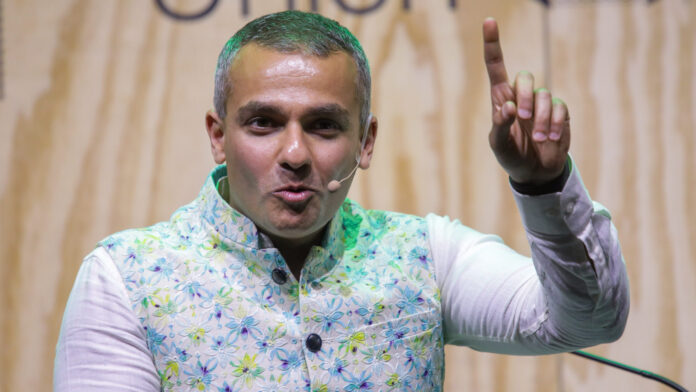
THE energy transition and its critical minerals supply chain has put mining into the orbit of government policy – with important consequences for the market, said Rohitesh Dhawan, CEO of the International Council on Mining & Metals (ICMM).
Delivering the opening address at the BMO conference in Miami yesterday, Dhawan said increased government oversight and participation in mining projects especially was keeping metals balances tighter.
Dhawan’s comments were part of his presentation of the 2025 Tax Contribution Report by the ICMM, which represents 26 of the world’s leading mining companies producing about a third of all metals and minerals.
In 2025, ICMM members paid $37bn in corporate income tax and royalty payments to governments, lower than in 2024, reflecting volatility and pressure on profits, the report said. However, the combined tax and royalty rate rose to 42.5%, against a historical average of 37%.
“So even as profits fell, a larger share of earnings flowed back to governments. That is not what early-stage commodity price cycles typically look like, where profits tend to outrun fiscal frameworks,” Dhawan said.
Since 2013, ICMM members have reported nearly $400bn in corporate income tax and royalty payments – equating to over $37 out of every $100 of profit earned. Dhawan said this counters the common perception that miners do not contribute to the wider society: “This is not value escaping the system. It is value being continuously integrated into public revenues – as it should be.”
The report highlighted the mining’s industry’s inherent cyclicality with overall profitability low compared to pre-pandemic highs as profit before tax, impairments and exceptional items reached $79bn in 2025, a decline of 7% on the previous year.
“Fluctuations in annual profits underscore the inherent risks associated with mining projects and reinforce the need for mining tax frameworks that encourage the substantial initial capital investment required for long-term and often high-risk mining operations,” the report stated.
Dhawan outlined the key characteristics of what he termed the current mining supercycle: “We have multiple, long-dated demand drivers arriving at once: energy transition and electrification; defence; supply chain reshoring; and, data centre infrastructure.
“Where this cycle diverges is in how tightly it is managed. In every historical supercycle, one dynamic dominated – markets ran ahead of politics. Today supply is mediated by permitting, ESG expectations, and geopolitics. Governments are intervening relatively early in the cycle – through stockpiles, export controls, offtakes, and fiscal mechanisms.
“So, instead of explosive price spikes, followed by overshoot and eventual collapse – we are likely to see persistent tightness and fewer avenues for uncontrolled expansion,” Dhawan said.
Beyond fiscal contributions, the report shows that ICMM members supported 582,000 jobs, paid $45.5bn in wages, spent $217.4bn with suppliers, and invested $1.6bn in community programmes in 2024.