


SHARES in Omnia Holdings are 88% higher over the past five years driven by a strategy to focus on the group’s explosives business through BME, a subsidiary.
Mining now accounts for the majority of earnings and while the firm’s traditional agribusiness provides a solid platform for cash generation, it’s in developing international markets in the East as well as Canada, the US and Australia where the upside exists.
For instance in 2023, Omnia bought a stake in the Swedish business Hypex Bio giving it access to environmentally friendly hydrogen peroxide explosives technology with a view to rolling out the product in Canada, and elsewhere.
Yet the market hasn’t fully recognised the stock. “Omnia trades at a discount to intrinsic value despite improving earnings quality, returns and capital discipline,” according to John Arron, an analyst for Standard Bank Group Securities in a recent note.
In addition, commodity markets have become yet more volatile. Geopolitical distress has made in-roads into offshore markets more difficult to traverse. While Omnia is expected to post strong full-year numbers for the year ended March – with a potential special dividend in the offing – the business environment is challenging.
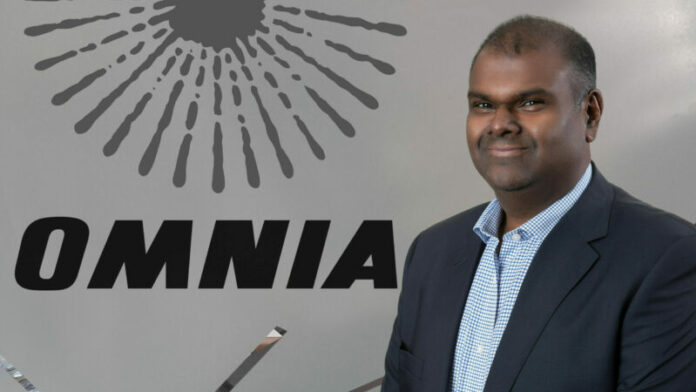
Miningmx spoke to Omnia CEO Seelan Gobalsamy.
Last year, you expressed concerns about the impact of tariffs, especially as you established a footprint in Canada. What is your assessment of the impact now?
We continue to invest in our plants in Canada with the intent of producing and selling in Canada and moving some of that product into the US. That is still financially viable for us.
I was quite worried about the East, the tariffs on India and other Eastern countries. But I think what you have seen since is a number of trade deals have been struck. From our perspective, it means our North Star of where we’re going and the strategy stays the same.
We have started thinking — which is the intent of tariffs — about where our production should lie. If you’ve got production in a territory that’s fairly vulnerable to tariffs, does that make sense? Obviously, between Canada and the US, maybe there’s an opportunity not just to bring product into the US, but also to produce in the US.
What we have to think about is not just the tariff, but the impact of the noise on the volatility in commodities and currencies. There has been an impact on global commodities and currencies. Take Zambia as an example: the kwacha has significantly strengthened during this period and that leaves the world a little bit out of sync. We’ve seen currencies being fairly volatile.
Having said all of that, I think we’ve got a fairly diversified portfolio of businesses in 23 countries across the world, so there are areas where you are hit due to the volatility in the currency, and there are others where you can gain on the opposite side.
The key for us is to manage that volatility, to maintain a strong balance sheet, which gives us strong optionality so that we can weather any storm. At the half year, we had no debt on our balance sheet, so we’re running our company fairly conservatively. We’ve made some strong investments in Canada, Indonesia, and Australia, and that allows us a strong balance sheet that gives us the optionality and flexibility to be more resilient.
Has the Trump administration’s negative attitude to ESG affected BME’s efforts to progress the hydrogen peroxide emulsion business?
Our ESG drive is an important part of what Omnia does, and it’s close to my heart. It’s something we’ve refocused the business on in BME, in our explosives business and our investment in hydrogen peroxide emulsion which we’re rolling out in Canada. In an environment like this, I think most large corporates still know it’s the right thing to do. Our investment in Hypex Bio and hydrogen peroxide emulsion really sets the mining sector on a new wave. Now, clearly, it disrupts us and it will disrupt some of our competitors. But what we have done is to invest in what is right for the environment. As the Omnia Group, we will continue to do that: use less fertiliser, less water, lower CO₂ emissions, and less ammonium nitrate explosives going forward — even if that disrupts us a little.
The plant has been built and is being set up in Canada. The business blasts in Europe very successfully. Maybe when you and I are retired — or maybe I am retired — some 50%, 60%, 75% of the world’s explosives will be green explosives. That’s where we need to go.
The ambition for BME was to derive half of its business offshore. Have you now ticked that box?
The business outside of South Africa has been growing by about 40% per annum in the last five years, including Africa. I think we’re doing well in terms of Indonesia. We’ve still got a lot of work to do in terms of Canada, Australia, the US … and one other market that we want to enter.
Which is where?
We will announce it shortly. The principle is partnerships — we find a strong partner that we can help, and they can help us, and together we explore those markets. So I think we’re well on the road to achieving that.
In terms of our overall business, Omnia is now more domiciled towards mining — the mining business is bigger. It results in less volatility from a soft commodity perspective and from commodity inputs into agri, which shortens our working capital cycle, increases our cash generation, and you see that year-on-year.
Omnia has paid out R5.5bn worth of dividends since its rights issue. The share price has gone up 20% in the last year. At the interims, BME accounted for about 54% of net earnings compared to about 49% previously.
Are you politically aligned in terms of East versus West?
If I’m pushed for an answer, I’d say we’re a little bit more aligned with the East. We have businesses in Canada and in the US, but our more significant businesses and customers are in Brazil, India, China, Indonesia, Africa, and Australia — and even in the Middle East. So, we’ve seen a lot of activity from customers and partners from the East engaging with us. I think the world is moving towards multipartisanship, which is really what the Trump administration has forced.
When we all went to business school, we were taught about a global village — supply chains, things can move around, you buy just in time, you manufacture anywhere in the world.
So how does multipartisanship change the way you think about strategy and capital allocation?
I think the first thing we’ve had to think about is localisation — localisation from an input perspective, from a production perspective, and from a storage perspective. We’ve gone and enhanced our storage capabilities in South Africa and at mine sites. We’ve gone and thought about where we produce and how we do things.
And there’s a bit of a swing towards: what should we do at the face of the customer? If you think of a farmer or a mine, they need to have a huge inventory of supply available immediately. When the rain comes, the farmer can’t phone somebody in depending on a ship coming through somewhere — it has to be on site.
So I think it’s disrupted supply chains and disrupted the way we think about doing things.
Yes, it’s also causing us to think carefully about capital allocation. Where do you put these plants? Do you want plants inland? Do you want them on the coast? There are a number of folk who are saying, if we’re in a territory, let’s move our plants to the coast because it gives us optionality to import and export.
So I think there will be a change in capital flows. There’s a little bit of dollar weakness, maybe a little bit of rand strength, maybe a little bit of positive sentiment on Africa and South Africa. Right now we’ve still got a lot to do to convert positive sentiment into results.
Omnia’s full year results normally see a strong, seasonally-driven second half from agribusiness. Can we expect that this year?
There are times in the cycle where agri will have a very good cycle. This is one of them currently — you know, agri has had a good rainy season, a good planting season, lots of hectares being planted, lots of fertiliser being sold.
But mining’s where it’s at for Omnia?
In terms of mining what we look at is: are we growing our volumes? Are we growing in the right territories we want to grow in? Are we continuing to expand the volumes in our mining chemicals business? And from all perspectives, we see very good growth. In Namibia, for example — we’ve been growing our metallurgy business and our chemicals into the lithium market. Locally we’re doing quite well. We not only sell our product through BME, but we also sell on a wholesale basis to global players that operate in the sector.
Outside of Africa, Indonesia is on track. Canada is also on track with a chunk of investment going in there. In Australia, if you look at what we did in Indonesia and Canada, we had partners and grew our business based on a partnership model.
So I’d love to have a partner in Australia at some point — we’ve been searching and looking for that. Maybe that will come through.