


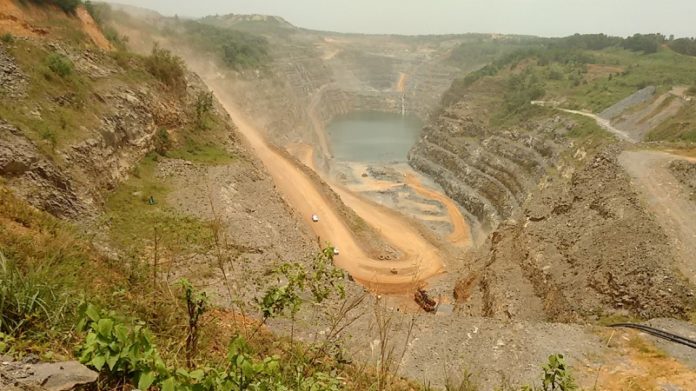
Gold Fields has warned that uncertainty over the renewal of mining leases at its Tarkwa mine in Ghana could have a “material and adverse” impact on the company.
This caution comes as higher gold prices and stronger production drove a sharp increase in profit for the six months ended 30 June 2026.
The gold producer said it was still waiting for a formal response from the Ghanaian government to a commercial proposal submitted in July covering the renewal of Tarkwa’s mining leases, which expire in April 2027.
There was no confirmed timetable for either a government response or the conclusion of negotiations, leaving uncertainty over the timing, outcome and terms of a deal.
“An adverse outcome of the renewal process would have a material and adverse impact on Gold Fields,” CEO Mike Fraser said in the results statement on Tuesday, 25 August.
He added that Gold Fields was considering all options available to it and could pursue its legal rights under the existing leases, its development agreement with Ghana and under law if required.
Gold mining in Ghana has become more challenging as the government seeks to increase the country’s share of the benefits from high gold prices.
In March, Ghana introduced a sliding-scale royalty regime, with the levy on gold revenue ranging from 5% when the gold price is $1,900/oz to a maximum of 12% when it reaches $4,500/oz.
Last year, the Ghanaian government declined to renew Gold Fields’ mining licence at Damang. The two parties subsequently reached an agreement allowing Gold Fields to continue operating the mine for another year before handing it over in April 2026.
Gold Fields confirmed on Tuesday that Damang was formally transferred to the Ghanaian government on 18 April.
Despite the uncertainty in Ghana, Gold Fields reported a strong financial performance for the six months ended June.
Gold-equivalent production rose 12% year-on-year to 1.27 million ounces, while headline earnings increased 81% to $1.86bn.
Adjusted free cash flow more than doubled to $2.23bn, boosted by higher production and an average realised gold price of $4,678/oz.
Gold Fields declared an interim dividend of 1,625 South African cents per share, more than double the 700c/share paid at the halfway stage last year.
It also allocated another $500m to additional shareholder returns, taking the total programme announced since November to $1.25bn.
Operational performance
Operationally, Salares Norte in Chile was the standout performer. Production jumped 173% to 337,000 gold-equivalent ounces as the mine completed its ramp-up and reached steady production. Gold Fields said strong plant performance through the start of winter meant Salares Norte was well placed to beat its full-year target.
South Deep in South Africa produced 151,000oz, 1% lower year-on-year, although performance improved in the second quarter.
At Gruyere in Australia, first-half production fell 17% to 120,000oz. Gold Fields said the mine was recovering from poor mining productivity and expected to reach its targeted production rate by the end of the third quarter, although it may not recover the ounces lost during the first half.
Gold Fields is also awaiting environmental approval for its Windfall project in Canada before making a final decision to build the mine.
The company reiterated that construction costs were expected to come in at the upper end of its $1.7bn to $1.9bn estimate, with environmental approval now expected in the second half of the year.
Forecast
For the full year, Gold Fields expects production towards the upper end of its 2.4Moz to 2.6Moz target, helped by Salares Norte.
Tarkwa and Gruyere, however, remain at risk of missing their individual targets.
Full-year all-in sustaining costs are forecast at $1,800/oz to $2,000/oz. Group capital spending has been lowered to $1.6bn-$1.8bn from $1.9bn-$2.1bn, mainly because some spending at Windfall has been reclassified as exploration expenditure.