




PORTS, logistics and rail specialist Grindrod has been gaining more steam in recent weeks.
Just before the end of April the share touched a five-year high of R22.26, giving the business a market capitalisation of almost R16bn.
Much of this recent share uplift is probably predicated on the site visit Grindrod organised to its operations in Mozambique for institutional investors and a smattering of analysts in late March.
The visit took in Grindrod’s crown jewel assets of the port of Maputo, where it has a 24.7% stake in the concession alongside Dubai Ports International (DPI) with 26.3% and the government of Mozambique with 49%. The concession runs until 2058.
The investor junket included the Matola dry bulk terminal, of which Grindrod owns 100% following a buy-out of its partner Vitol’s 35% in September 2024 for $77m. That deal was transformative, Grindrod’s management commented at the time.
The two-day visit was hosted by Grindrod CEO Kwazi Mabaso and CFO Fathima Ally. On-the-ground insights were given by dry bulk terminal COO Pedro Poh-Quong alongside Maputo Port Development Company (MPDC) COO Marla Calado, with a presentation from MPDC CEO Osório Lucas.
The competence and can-do attitude of the local management at the port of Maputo would make Transnet blush, especially because, though Mozambique is a socialist country, it operates a capitalist and successful port concession.
Veteran analysts who have covered Grindrod agreed that since the previous site visit in 2019 the port and terminal operations have been busier and better organised. The congestion and bottlenecks seen almost seven years ago have largely been alleviated to allow higher throughput. Improved control room communication systems and logistics have materially enhanced efficiency and aided group volumes and profitability. And there remains significant potential in the operations, especially at wholly owned Matola.
Both assets are important for Grindrod in the Transnet public sector participation (PSP) process now under way.
Much of the cargo moving through the Maputo port and Matola is minerals mined in South Africa and exported via road and rail corridors to Maputo. Chrome, ferrochrome and magnetite are the main commodities, though graphite, vanadium, coal and phosphates are also important minerals to Grindrod.
The Transnet Rail Infrastructure Manager is a dedicated entity, established to manage, operate and maintain South Africa’s rail network. It separates infrastructure management from train operations. Its implementation will allow private entities such as Grindrod to operate its locomotives and wagons on dedicated routes. Grindrod has locomotives and wagons ready and is the only JSE-listed stock that gives investors access to this PSP potential.
Turning the clock back
The potential of this scenario was discussed by Calado, who said delays have been minimised and bottlenecks identified and quickly resolved. There has been a major improvement in efficiency. All of this was due to the rise in communications and information flows between the relevant stakeholders: Transnet, Grindrod and Mozambique state railway operator CFM.
Efficiency results in greater volume and thus more profit.
Komatipoort in Mpumalanga serves as a primary, high-volume transit point for South African mineral exports, specifically magnetite, chrome, coal and manganese transported via the N4 highway and rail to the Maputo port for international shipment.
Two years ago this 80km rail journey to Maputo took 108 hours, including the time needed to load and unload. It has been slashed; the turnaround time in the first quarter of 2026 was 36 hours, and the intention is to bring that down to 30 hours. It is an astonishing feat.
On the road transfer side, control room improvements in communication logistics brought about a similar change. The historic 500 trucks a day that arrived with a three-hour turnaround time at the port has leapt to more than 1,000 trucks a day and a one-hour turnaround.
Room to grow
These initiatives at Grindrod port and terminal operations have rocketed volume throughput. And there is more to come, as the capacity to manage what arrives is expanded via storage, wharf and equipment handling capex.
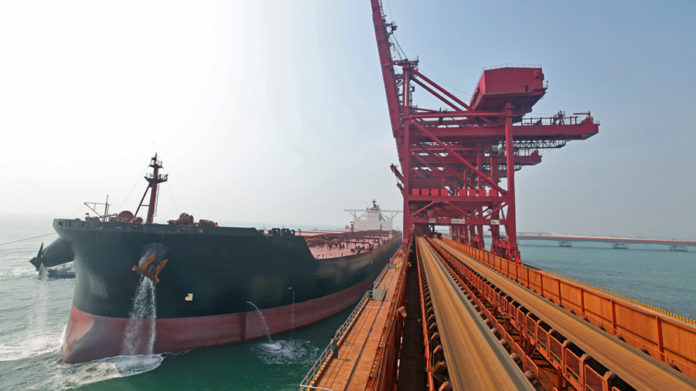
Overall, 32Mt was handled at MPDC, and there are plans to expand throughput to 42Mt in 10 years. Much of this increase in tonnage will result from greater efficiency in turning cargo around — at present it can take nine weeks. Improving that to five weeks (global competitors can do it in three) will enable higher throughput volumes from the existing MPDC footprint. Grindrod says the use of mechanisation such as conveyor equipment will greatly speed up ship loading.
In the consortium partnership, DPI is expanding its container terminal from 255,000 20-foot equivalent units (TEUs) to 530,000 TEUs, and planning to add capacity for an additional 2,2Mt of chrome is under way. Chrome is one of the major cargoes Grindrod manages.
Grindrod’s operations within the MPDC are dry bulk and Maputo Car Terminal (MCTL).
Surging quantities of chrome aided Grindrod’s earnings. Own-handled volumes at the Maputo port rose 6% to 15.2Mt in 2025.
At MCTL, there is capacity for 20,000 passenger vehicles a year alongside commercial vehicles and construction equipment. The facility handled 12,000 passenger vehicles in financial year 2025, mostly grey or second-hand or vehicles in trans-shipment.
During the visit to the MCTL site the area was full of luxury vehicles that had been offloaded to park there due to the conflict in the Middle East. Grindrod will earn extra fees for this extended time. The FM understands that in February the site handled 6,000 vehicles, compared with the 12,000 traditionally dealt with there in a year. Again, the Middle East conflict was the cause.
The Matola factor
In 2025, Matola handled a record 9,9Mt, mostly magnetite. This is why Mabaso described the acquisition of the remaining 35% in the terminal as “transformational”. About 800 rail wagons a day are dealt with and unloaded at Matola. There are plans for tonnage throughput to be greatly increased.
One key aspect of Matola is to increase the capacity at the back of the terminal. Greater storage footprints and improvements in equipment, together with enlarging dredging wharves to 16 metres, will allow larger 170,000t vessels to dock and enable faster loading at increased efficiency. Volumes will rise in phase 1 from the current 9,9Mt to 12Mt, with phase 2 moving to an eventual 15Mt-17Mt. Mabaso says this, too, will be game-changing.
Considering the $40m to be invested at Matola; the ongoing incremental uplift at MPDC; the potential for the Richards Bay dry bulk operation; and the boost that rail open access gives to revenues, volumes and port throughput, Grindrod has plenty of heat in its boiler.
The writer holds shares in Grindrod
This article first appeared in the Financial Mail’s Investor’s Monthly edition.