





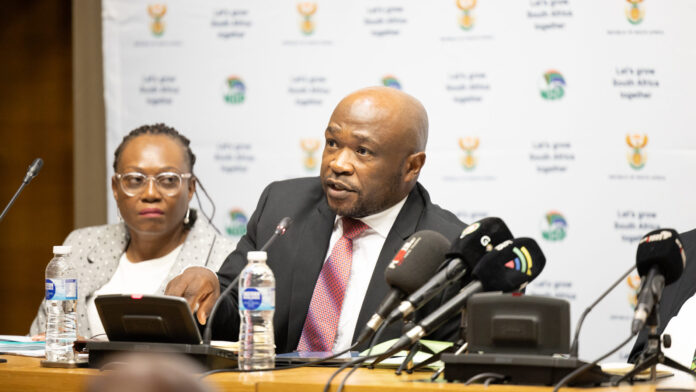
SOUTH Africa’s new minerals cadastre had been successfully rolled out in the Western Cape and would be implemented nationwide within the next 12 months, said Jacob Mbele, director-general of the department of mineral and petroleum resources.
“As I sit here today … the Western Cape has fully migrated from the legacy system onto the cadastre,” said Mbele. “At last count, we already had three applications submitted unassisted that had been put through the system and reviewed,” he added.
“The system is working. We are now looking at moving to the Free State, KwaZulu-Natal and the Eastern Cape. We recognise that we need to move with speed.”
Mbele was speaking at the Junior Indaba, a conference at which he said the new cadastre would be fully implemented by the end of the DMPR’s financial year ended March 31, 2027. “We will get there,” he said.
Doubts about the minerals cadastre, a system that administers new mining and prospecting licence applications, as well as renewals, was raised by the Minerals Council South Africa at its annual general meeting on 27 May.
There were concerns whether the cadastre was operating to design specifications because the council had not been given sight of the system, despite requesting the Government to give a demonstration.
Miningmx understands the DMPR will present the cadastre to the Minerals Council this week. The system is also available for public scrutiny.
Mbele said implementing a new cadastral system for South Africa was time-consuming owing to its many legacies. “Many other countries don’t have the complexity that we have,” said Mbele. “We’ve been mining for hundreds of years, and there’s a lot of data to move from the current system into the cadastre,” he added.
Mbele was criticised, however, for saying there was no policy uncertainty. “I think we are actually creating a perception of policy uncertainty that is not fully warranted,” he said – to which Bernard Swanepoel, convener of the conference, referred to the department of trade industry & competition’s new industrial development strategy (IDS), published on Monday.
The IDS links the award of mining licences to unspecified beneficiation targets, and also calls for the imposition of a chrome export tax – something the industry had considered to have been ditched. “How is this not policy uncertainty?,” Swanepoel asked.
“Where the DTIC speaks about attaching conditions to mining licences, I am aware of the broader beneficiation debate,” said Mbele, who added it was “a proposal”.
In the IDS, the DTIC said: “A review of mining legislation on the allocation of mineral rights is critical to enable the government to attach conditions that must facilitate beneficiation, and this must be in line with international mining, trade and investment laws.
“This shift is crucial because it will allow beneficiation objectives to be embedded in mining licensing decisions.” Elsewhere in the strategy document, Goverment plans to: “Institute the tariffs or negotiated pricing agreement for the chrome sector”.
Mzila Mthenjane, CEO of the Minerals Council said the document was “an invitation for, amongst others, the Minerals Council to engage”.
“That’s a 45-page document that basically needs careful attention, and we need to engage with it,” Mthenjane added.