



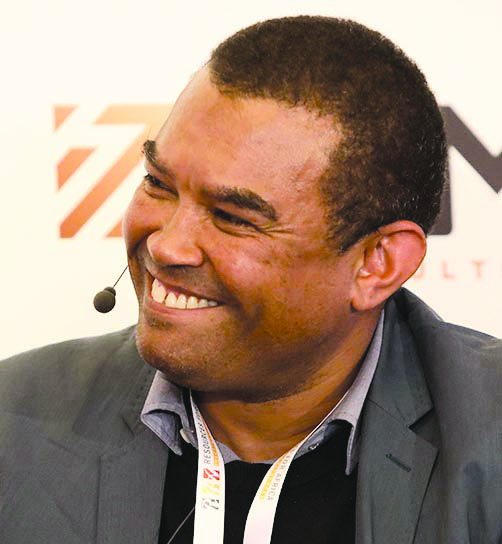

Rudi Dicks
HEAD: PROJECT MANAGEMENT OFFICE: Presidency of South Africa


'In my view, there’s a misunderstanding about … the complexities of reforms'
RUDI Dicks has become a key figure in South Africa’s economic reform agenda. He is most closely associated with Operation Vulindlela, the Presidency-led programme responsible for driving structural reforms to stabilise the economy and improve investment conditions. Much of his recent attention has been directed towards the rollout of Phase II of Operation Vulindlela. While the first phase focused on electricity reform and digital communications, the second phase broadens the scope to include local government reform. It also directs attention to reforms in water and logistics, including efforts to allow more private-sector participation in state-owned entities such as rail and ports.
Dicks has publicly stated that gross fixed capital formation needs to rise to between 18% and 20% of GDP to achieve growth of around 3%. That requires a significant boost in investment – potentially more than R1 trillion above current levels, although he pointed out that reforms to date have already unlocked approximately R500bn, mostly in renewable energy projects. Dicks has been frank about the constraints facing government; he has highlighted the deleterious effects of crime on the economy, noting that copper theft and construction mafias erode as much as 10% of growth potential.
Dicks has defended the pace of government reform, such as the unbundling of Eskom and improvements at Transnet, arguing that legal requirements and transaction processes make these complex and time-consuming. He has identified 2026 as a critical year in which the establishment of the South African Wholesale Electricity Market will come into effect, while private-sector operators will enter into the rail network.
LIFE OF RUDI
Beyond his role as the public face of Operation Vulindlela, Dicks oversees several other high-priority initiatives in the Presidency, including two job-creation programmes and the Just Energy Transition Investment Plan, which supports South Africa’s shift from coal-based energy to cleaner sources. He previously led socio-economic policy at the Department of Planning, Monitoring and Evaluation and served as executive director of the National Labour and Economic Development Institute. He holds an MSc in economic finance from the School of Oriental and African Studies, University of London, and has roots in the trade union movement dating back to the early 1990s.