
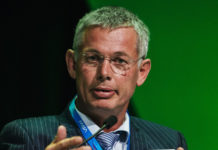

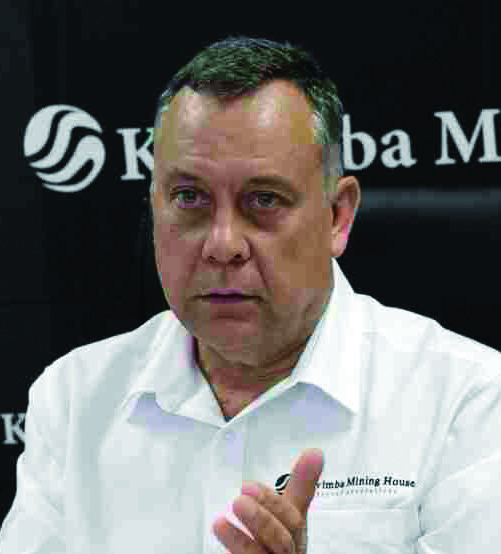

Trevor Barnard
CEO: Kuvimba Mining House


‘Our projections indicate lithium will recover in 2027, precisely when we expect the concentration plant to start production’
At the beginning of 2025, Trevor Barnard optimistically declared the floodgates would open as funders sought to participate in Kuvimba’s various Zimbabwe projects. The company’s improved prospects would be brought about by a change in management, he felt. Previous attempts to raise funding had been hamstrung by speculation; specifically, the identity of private investors.
Six months later, Barnard took a slightly different approach. Out went ‘big bang’ plans, hatched in 2014, to list the company’s $450m Darwendale platinum project. In came a more serviceable $50m open-pit ‘starter’ project which, in today’s uncertain market, makes sense. In fairness to Barnard, Darwendale’s original scope was the work of Russian backers who were linked with Kudakwashe Tagwirei, a one-time presidential adviser, and since sanctioned for corruption by the US and UK. Kuvimba is also working on a lithium project: the $270m Sandawana.
Unveiled in July 2025, the project will produce 600,000 tons a year of lithium concentrate. Sandawana has its recent origin in 2024 when a $310m plan was supported by a consortium of British and Chinese investors. Chinese investors are still involved in Sandawana, but there doesn’t seem to be clarity as to their identity — potentially repeating Kuvimba’s past mistakes on disclosure. The lithium price is under pressure while Zimbabwe looks to impose a concentrate export ban from about 2027. Neither of these factors is helpful to Sandawana.
LIFE OF TREVOR
A mechanical engineer with an MSc from the University of Pretoria, Barnard has history with lithium, having worked at Australia’s Prospect Resources, which sold its Arcadia project to China’s Zhejiang Huayou Cobalt Co for $387m. He took up the reins at Kuvimba in December 2024 and was previously its energy cluster head. Prior to that, Barnard worked for five years at cement maker PPC’s Democratic Republic of the Congo operations. Working life began in the 1990s. As many South African miners have done, that was at De Beers and Anglo American.