




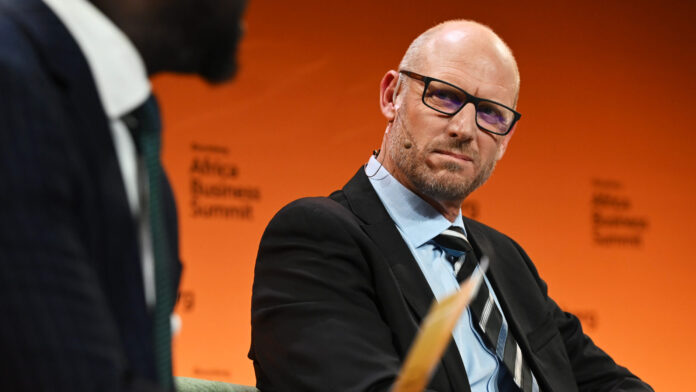
SIBANYE-Stillwater CEO Richard Stewart described the firm’s recently approved R5.5bn Mt Lyell copper project in Australia as “juicy” with significant resource expansion potential.
It also contained by-products that could help finance the project without resorting to debt, a critical consideration for Sibanye-Stillwater under Stewart’s watch. The halving of Sibanye-Stillwater’s gross debt in two to three years’ time is a key deliverable.
“I once had a professor who said that when you’re exploring, you look for juicy plumbing systems — and this is juicy,” said Stewart at the group’s interim results presentation today when asked about approving the mine’s restart.
“The opportunity to expand that resource into a much bigger project is significant; it’s genuinely interesting geology.”
Sibanye-Stillwater will spend about A$11m ($7.5m/R136m) on Mt Lyell in 2026 for production of up to 26,000 tons of copper a year in 2029. In addition to copper output, Mt Lyell, near Queenstown in Tasmania, is also expected to produce about 16,000 oz of gold a year and 116,000 oz of silver annually once in steady state.
“The one thing we’ll continue to look at carefully with Mt Lyell is that it has some interesting by-products in gold and silver, alongside the copper, and there’s a lot of interest in off-take,” he said. “So, could there be smart ways to help finance this using some of those by-products? That’s something we’ll keep exploring in more detail.”
Sibanye-Stillwater has been assessing Mt Lyell’s prospects since 2023, during which time the spot price for copper has increased 73% to just over $6,500 per ton. That is clearly a driving factor behind the decision to invest in a distant project when the main strategic focus as per a capital markets day in June is for Sibanye-Stillwater to exploit its existing platinum resources.
According to Ralph Lombard, head of organic growth and projects for Sibanye-Stillwater, the retention of the mine’s care and maintenance team also means the decline remains in “extremely good shape,” though the vertical shaft needs to be refurbished at a cost of $74m and infrastructure needs improving. A new concentrator also has to be built.
Still, refitting old mines is not a question of throwing a switch. Harmony Gold said its $1bn CSA mine acquisition, also a copper/gold restart in Australia (in New South Wales), required two years of debottlenecking and derisking.
Less surprising for Sibanye-Stillwater is the decision to press on with the reopening of Burnstone, a gold mine in Mpumalanga province in South Africa. Burnstone will produce about 130,000 ounces of gold a year at steady state and has an estimated 25-year mine life. Sibanye-Stillwater plans to spend R3.5bn on project infrastructure over six years, with the processing plant expected to start in 2029.
Stillwater
While Burnstone was expected, despite earlier concerns about empowerment obligations potentially derailing its feasibility, Mt Lyell is an interesting decision. Analysts attending the interim presentation are already concerned that sticking with the loss-making Stillwater platinum and palladium operations in the US is an unnecessary distraction.
Charles Carter, head of Sibanye-Stillwater’s international operations, is chasing a $1,000/oz all-in sustaining cost for Stillwater mine, which he hopes to achieve through mechanisation. It does require a change of mind and heart among the mine’s workforce, who he acknowledged are resistant to change. The acid test is signing a new wage agreement at Stillwater that implements a team-focused incentive approach, replacing the 20-year “legacy scheme” focused on individual mineworker performance.
Asked by Steve Shepherd, a former platinum analyst, if Stillwater was worth the risk/reward – palladium, which Stillwater mostly mines, is not expected to run the same supply deficits as other PGMs – Richard Stewart alluded to the mine’s option value as a geographical diversifier to Zimbabwe, South Africa and Russian PGM production.
He added, though, that patience with Stillwater was limited. “We do have a plan that gets us to $1,000. If we can’t, there will be a point where we call it. If we can get there, it’s absolutely one of the best PGM deposits in the world; there’s 40 to 60 years, possibly up to 100 years, of mining,” he said.
Stewart was referencing Stillwater mine, though in reality, Carter is focused only on Stillwater East, the part of the mine that remains open. When asked if Stillwater West could be reopened in the future, effectively comprising a new brownfields project, Carter was pragmatic, saying “I don’t see it as a full mine standing up immediately,” and that it would have to compete for money with other projects.