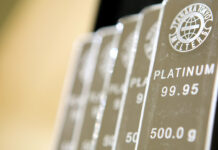





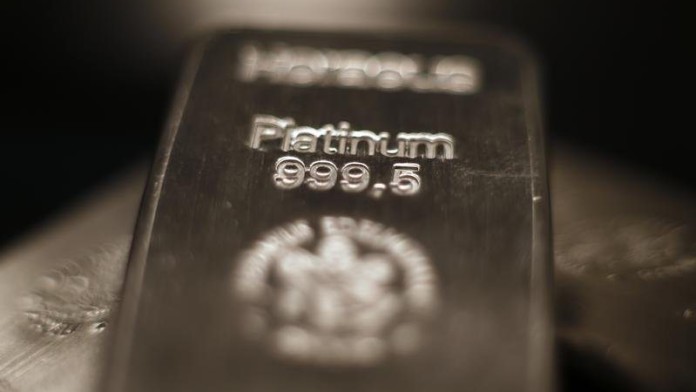
PLATINUM has been on the wrong end of the Middle East crisis falling 13% since hostilities between the US and Israel and Iran began. Yet industry mavens who gathered for the annual London installment of Platinum Week last week agreed the metal will klck on. Supply is falling; demand is rising – its 89% price increase in a year notwithstanding.
“I would hesitate to suggest prices will double again,” said Ed Sterck, director of research at the World Platinum Investment Council, an industry-funded body. “But if prices have already doubled from last year and yet we still have deficits …?
“It’s commodity market economics 101: how do you solve a deficit? One way is higher prices to incentivise new supply. That’s not really working. Higher prices should also incentivise lower demand, and that’s not really working either. So, the market tension is still very much extant.”
What a turnaround it’s been for the white metal. In fact, it was at Platinum Week in London last year when its price began its remarkable recovery, following a long slump. The start was news that there was significant buying of platinum by wholesale jewellers in China. “That was the visible factor,” said Sterck. “But the less visible factor was actually that above-ground stocks had been depleted to unsustainably low levels.”
Promisingly for PGM miners, not much has changed in a year: the WPIC has forecast another platinum deficit for 2026. This is despite an expected 50% redemption in investor positions through exchange and ETFs, and as buyers leave the expensive jewellery market. The WPIC’s deficit forecast year on year is a reduced one, but a deficit nonetheless.
“We see no evidence of a structural decline in demand or a meaningful acceleration in the shift to electric vehicles,” said Arnold van Graan, an analyst for Nedbank Securities. EV adoption is expected to heavily diminish platinum demand in the future, but that future seems farther away. “Supply remains constrained, while recycling [secondary supply], though a risk, is unlikely to materially alter market balance in the near term,” he added.
From a South African equities perspective, platinum is not the whole story. The so-called minor platinum group metals that are mined with platinum, such as ruthenium and rhodium, have different, and complementary sources of demand, some of it uncharted.
“Data centre construction will be positive for platinum and ruthenium, which are critical for the magnetic layers used to store data on hard disks,” said Rupen Raithatha, market research director at Johnson Matthey, a semi-fabricator and industry consultancy. “This year should also see the first commercial-scale use of iridium in proton exchange membrane (PEM) electrolysis for green hydrogen,” he says.
“On aggregate, the iridium deficit is expected to increase year-on-year in 2026 while ruthenium deficit is expected to decline but remaining substantial at about 14% of demand,” said Investec. “The two minor metals together with platinum are expected to be the biggest beneficiaries of AI-linked demand in 2026 and beyond.”
This is positive news for investors in South African platinum shares, even for those not customarily disposed to it. Unlike gold in South Africa, PGM production has a long-term investment “story”.
Inflation factor
There are short-term risks. The oil price shock is central among inflation factors posed by the Middle East crisis. Adrian Hammond, an analyst at Standard Bank Group Securities, estimated 2%-4% additional inflation as a result of the war and the political standoff that is under way. Valterra Platinum is an outlier in this regard: it may post up to 7%-10% in increased input costs.
Investors have also adjusted their outlook as a result of the conflict. “If you’re operating a multi-asset portfolio and you need more collateral for your energy positions after precious metals prices have risen, those holdings are an easy source of liquidity to back your energy positions,” said Sterck. There’s also been more support for the dollar ahead of possible interest rate reductions, a negative for commodities.
Another consequence of energy inflation is a pulse in battery electric vehicle (BEV) market absorption. The pure BEV drivetrain uses no PGMs, and hybrids less than the internal combustion engine. First-quarter BEV sales are flat year on year, according to RMB Morgan Stanley, but in March alone BEV sales in Europe increased 41% year on year with pure BEV penetration approaching 25%. This is a notable comeback from last year when the cancellation of US government tax credits for BEVs, and a parallel end in subsidies in China, weighed on the sector.
Exogenous events aside, the key fact for JSE investors is that South African platinum shares remain powerfully cash flow positive. Spot free cash flow yields at Sibanye-Stillwater and Northam Platinum were 11.6% and 10.5% respectively at the time of Hammond’s report on May 11, when the spot PGM basket price was R43,000/oz — relatively robust in the context of Middle East tensions vs R52,000/oz pre-war.
Northam remained Hammond’s preferred pick. Sibanye-Stillwater and Impala Platinum are more leveraged due to their overall higher cost. Valterra is long-life with major production growth in its reach, though CEOs in the sector are at pains to keep growth capex under wraps, at least for now.
There’s also a case to be made for some of the smaller PGM miners. “We identify the best value in the small-caps, with Tharisa and Sylvania Platinum being our favoured picks. Tharisa has clear growth potential from its Tharisa mine in South Africa,” said Richard Hatch, an analyst for Berenberg, a bank.
Sterck is confident of a strong recovery in PGM support in the remainder of the year. “As things settle down in the Middle East, people will be looking again not just at interest rates but at what the impact of those interest rates is on the US balance sheet, and looking for alternatives to holding dollars and treasuries,” he said.
Futures
Platinum Week London is just one instalment. Another event is planned for Shanghai in July, by which time there may be a resolution to the Middle East war. This could send investors back to metals from energy.
One sidelight worth watching is the Guangzhou Futures Exchange, a commodities derivative exchange launched in November. Contracts totalling 500,000 ounces were amassed in its first month, and while they can be rolled forward, some metal will be delivered. In this fevered atmosphere, PGMs roll on.